A cash offer is capped by whatever the buyer does with the house next, and on this one there were two honest answers. The house is 1,044 sq ft and needs a $70,000 renovation: air conditioning, water heater, a full repipe because the plumbing is polybutylene, a new electrical panel, and then a new kitchen, bathrooms, flooring and paint. The roof was permitted in 2020, so that is the one line it does not need. Renovated, the comparable sales say it lists at $250,000, and with one price drop budgeted in it is underwritten off $225,000. Back out a 20% profit margin, the costs of sale, the renovation and the money, and the cash offer is $81,081. But this is a buyer’s market: the pace of sales here halved over the last six months, from about 2.2 closings a month to 1.0, and all five homes currently for sale have already cut their price. So it also had to be underwritten as a rental: at $1,800 a month the house only supports about $132,792 of long-term debt, and once the renovation and the financing come out of that, the number it can pay is $47,000. Those two answers are $34,081 apart, and nobody knows today which one this becomes. Rather than price that uncertainty into the seller’s number, the offer splits it: $65,000 cash, on whatever closing date she picks.

Real Offers · Southside Jacksonville, off Barnes Road near Drew Park

I Underwrote It Twice and Split the Difference

By Bryce Spraggins · November 1, 2026

1,044 sq ft · single family · roof permitted in 2020 · polybutylene plumbing and an outdated electrical panel · needs a $70,000 full renovation · rents for about $1,800 a month once it is done

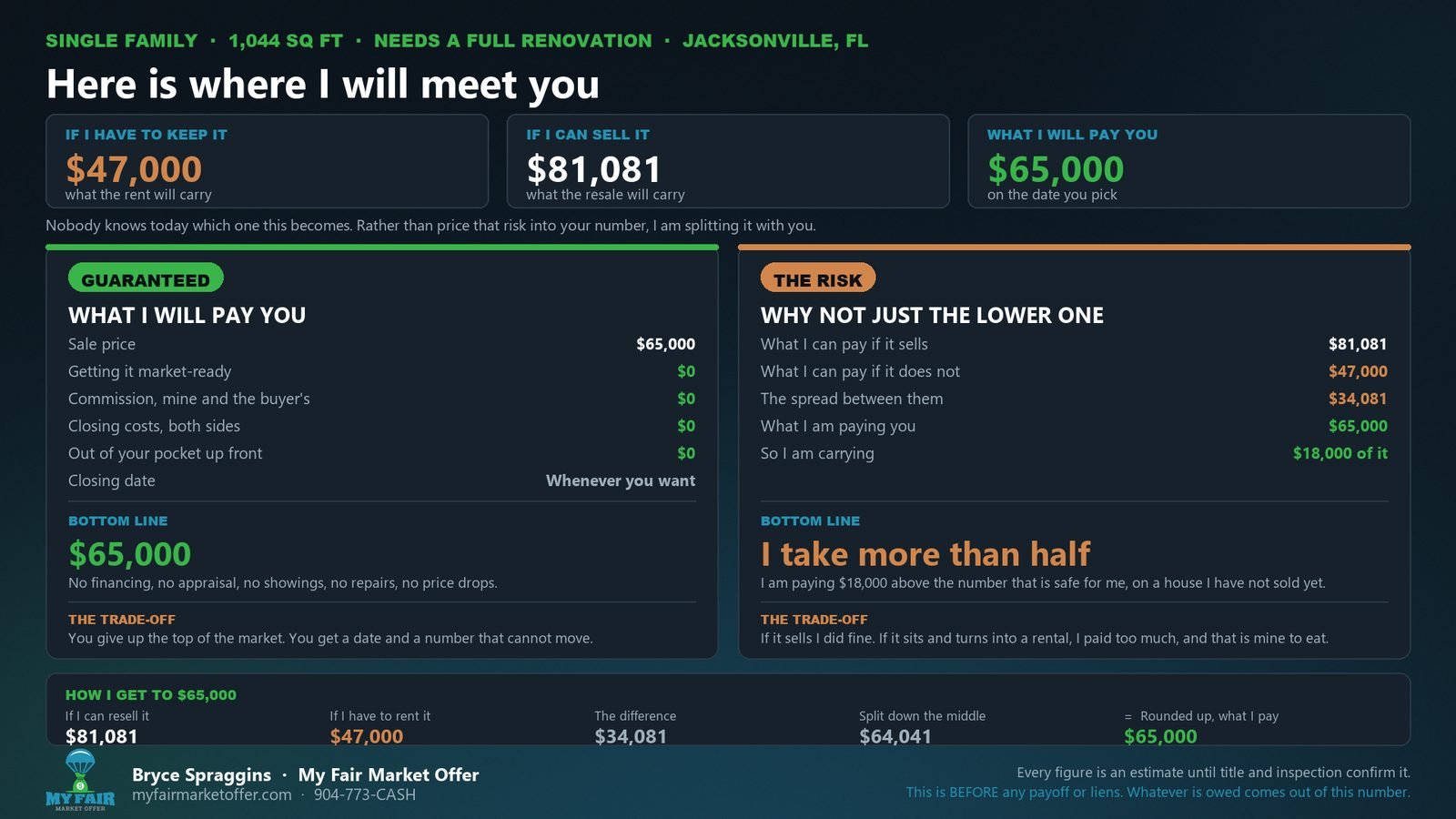
A 1,044 sq ft house needing a $70,000 renovation, underwritten twice on camera. To resell it: $81,081. To keep it as a rental at $1,800 a month: $47,000. The cash offer was $65,000, the split between them.

The address and the homeowner's name are never shown. Everything else — the condition, the comps, and the number — is exactly what happened.

Two ways to underwrite one house, and the number in between

November 1, 2026

A $70,000 renovation, a $250,000 list price with one drop built in, and a rent of $1,800 a month that only carries $132,792 of debt. The resale says $81,081, the rental says $47,000, and the offer is $65,000.

How This Number Was Built

This is a 1,044 sq ft single family house in Southside Jacksonville that needs just about everything. The seller asked for a cash offer. She got one number, and the whole video is about why it took two completely different pieces of arithmetic to arrive at it.

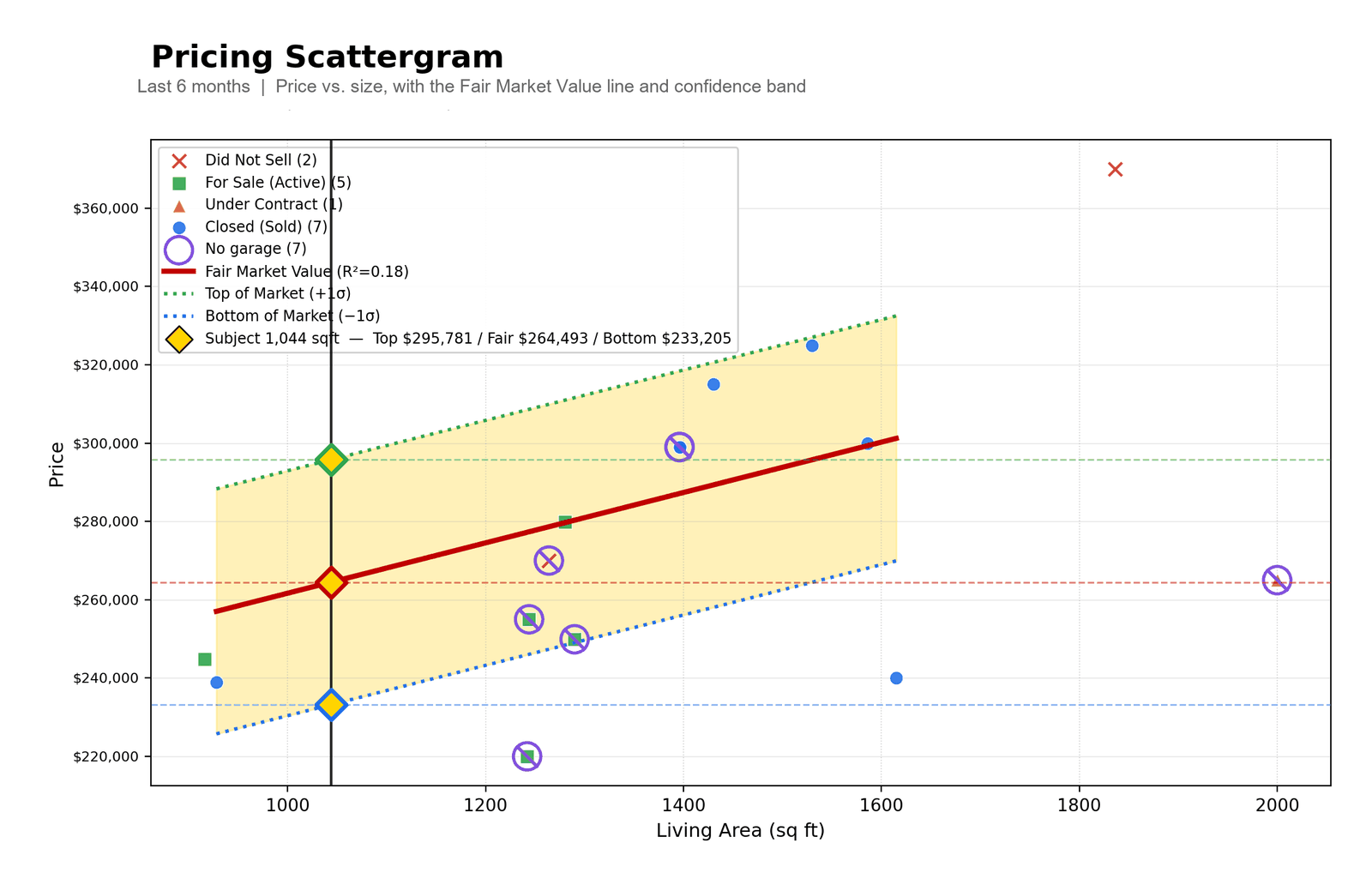
The comp pull came first, and it was deliberately hyperlocal. Not a radius, just her immediate area, pulling everything that sold, is for sale, or tried to sell and failed. Two years of data gets pulled; only the last six months gets read, because older sales describe a market that no longer exists. Those comps go into a scattergram that plots price against living area and draws three lines: a top of the market, a bottom of the market, and the fair market value line through the middle.

The top line was not used, and the reason matters. This is a buyer’s market right now, and the sales record shows it turning over inside the last year rather than sitting still. In the six months before last, 13 homes closed here, about 2.2 a month. In the six months since, 6 closed, about 1.0 a month. The pace halved. There are five homes for sale right now and every one of them has already cut its price, one of them by $59,900. At the current pace that is five months of standing inventory, and the listings that never found a buyer at all are the expensive ones. So the read came off the fair market value line, which at this size sits a little above $260,000. Listing never happens on an odd number, so that rounds down to an even $250,000. That is what this house lists for, fully renovated, in perfect shape. Then one price drop gets budgeted in before the sign ever goes up, which takes the working resale to $225,000. Every number after that is backed out of $225,000, not out of $250,000.

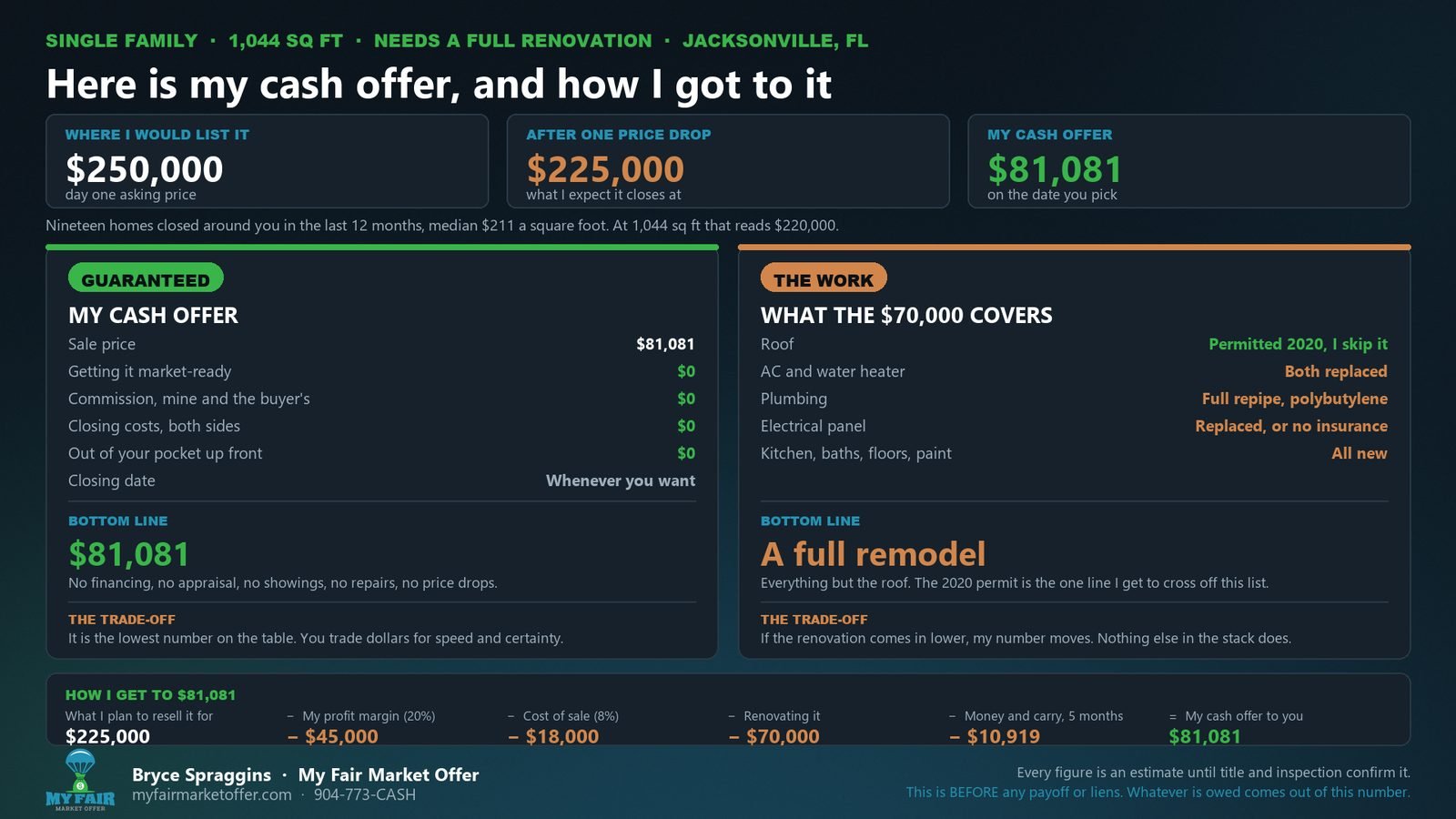
Then the renovation. The permits showed the roof was done in 2020, which is one line crossed off. Everything else is on the list: air conditioning, water heater, a full repipe because the plumbing is polybutylene, and a new electrical panel, which is not cosmetic. An end buyer cannot get a homeowner’s insurance policy on the house until that panel is replaced, so it is not optional work. After that it is the normal full remodel: new kitchen, new bathrooms, new flooring, new paint. Call it $70,000. Take that off the $225,000, take off a 20% profit margin, take off the costs of sale and the cost of the money, and the cash offer is $81,081.

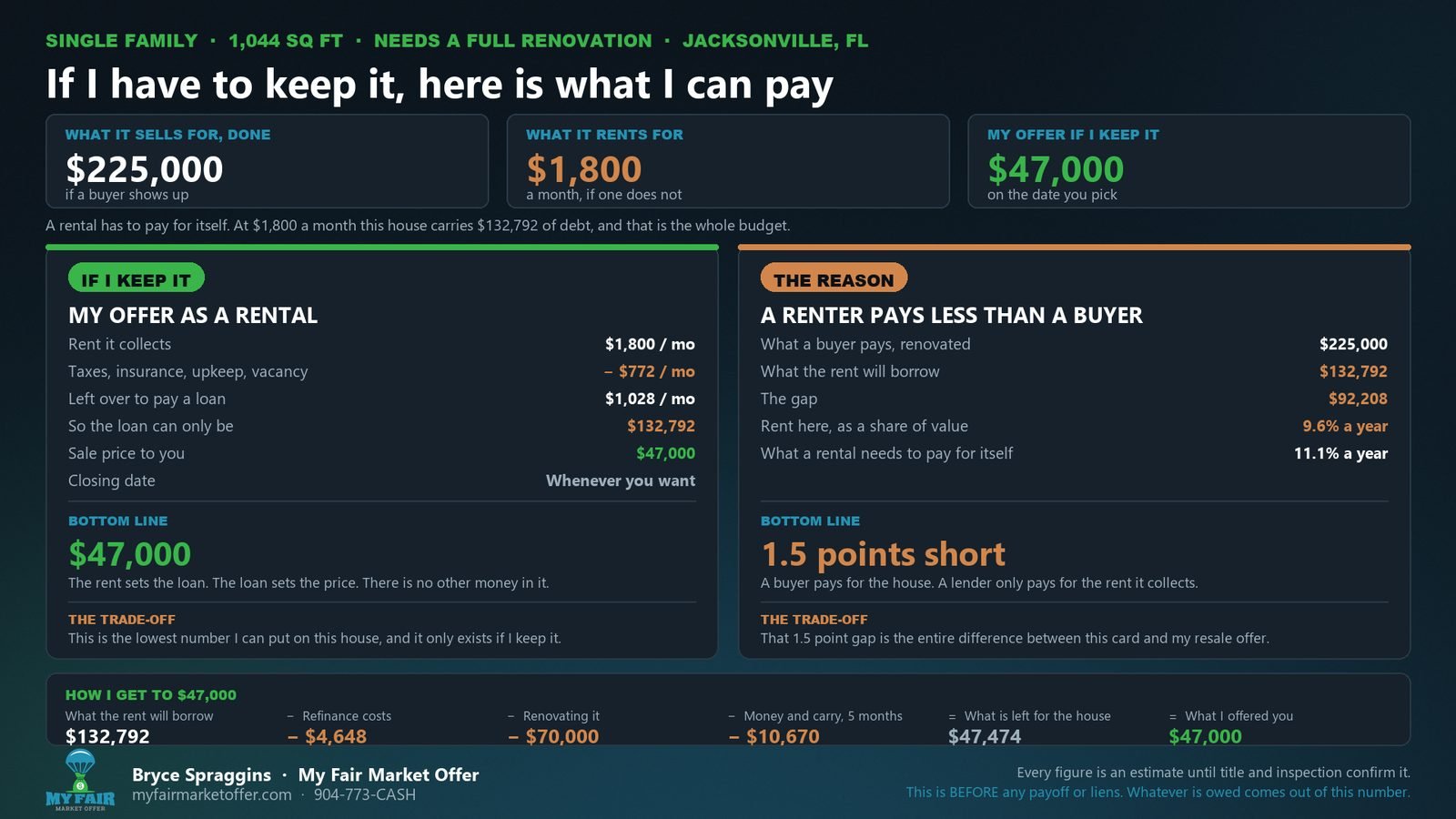
That is one way to underwrite it. In this market it is not the only way. There are houses sitting right now that should be selling in this price range and are not, simply because there are fewer buyers than there were. So the same house has to be underwritten a second time, on the assumption that it does not sell and has to be kept as a rental instead. Renovated, the rent reads about $1,800 a month. A rental has to pay for itself: long-term debt goes on it, a tenant pays rent, and the rent has to cover the mortgage payment with something left over. At $1,800 that math only supports about $132,792 of debt, and once the $70,000 renovation and the financing costs come out of that, what is left to pay for the house is $47,000.

Two honest answers, $34,081 apart. $47,000 is a lot lower than this offer would be in a market anyone was confident about. $81,081 assumes a sale that has not happened yet. Nobody knows today which one this house becomes. So rather than price that uncertainty into the seller’s number and keep the benefit, the offer splits it down the middle and rounds up: $65,000 cash, closing in about two weeks, or thirty or sixty days out if the family needs the time to get the house emptied.

And the option that is usually on the table was taken off it. Normally the alternative offered is to list the house on the open market with a Realtor. Not this one, not in the shape it is in. If the family can do the $70,000 of work themselves, then listing at $250,000 is absolutely the better outcome and the video says so plainly. If they cannot, the cash offer is the honest alternative, and the number is $65,000.

The Actual Comps

These are the real charts this offer was priced from — not a re-creation.

The cash offer of $65,000 shown as the split between the resale number and the rental number
The offer, and where it sits between the two answers. Underwritten to resell it the house supports $81,081. Underwritten as a rental the same house supports $47,000. The spread is $34,081 and the exact midpoint is $64,041, which rounds up to the offer of $65,000. Nothing about which exit this becomes is known today, so the uncertainty gets split rather than priced into the seller’s number. (Click to enlarge.)
The resale underwriting, from the list price through the renovation to the cash offer
The resale arithmetic. List at $250,000, budget one price drop, underwrite off $225,000. Out of that comes a 20% profit margin of $45,000, $18,000 of costs of sale, the $70,000 renovation and about $11,000 of money and carry over five months, landing on $81,081. The right-hand column is the renovation itself: the 2020 roof is the only thing that comes off the list. (Click to enlarge.)
The rental underwriting, from the monthly rent through the loan it supports to the lower offer
The rental arithmetic, which is a completely different calculation. $1,800 of rent, less about $772 a month of taxes, insurance, upkeep and vacancy, leaves roughly $1,028 to make a mortgage payment. A thirty year loan sized to that payment is about $132,792, and that is the entire budget. Take the renovation and the financing out of it and the house can pay $47,000. Rent here runs 9.6% of value a year; a rental that pays for itself needs closer to 11%. (Click to enlarge.)
Pricing scattergram of recent neighborhood sales plotted against living area, with the fair market value line and confidence band
Every comparable sale nearby over six months, plotted against living area. At 1,044 sq ft the line reads fair market value $264,493, with a top of $295,781 and a bottom of $233,205. Two things to read honestly. The R² is 0.18, which means size explains very little of what price does here, and this house is smaller than almost every comp in the set, so the line at its size is an extrapolation rather than a measurement. What rescues it is the two sales that genuinely are this size: a 928 sq ft home that closed at $238,900 and a 916 sq ft asking $244,900. Both land on the $250,000 list price without the regression having anything to do with it. (Click to enlarge.)

Common Questions

Why would a cash home buyer underwrite the same house two different ways?

Because a cash offer is capped by whatever the buyer does with the house next, and there is more than one thing he might end up doing. Underwritten as a resale, the question is what it sells for renovated, which here is a $225,000 working number after one planned price drop. Back out the renovation, a profit margin, the costs of sale and the cost of the money and that supports $81,081. Underwritten as a rental, the question is completely different: what will a tenant pay, and how much long-term debt will that rent carry. At $1,800 a month the answer is about $132,792 of debt, and once the renovation and financing come out of it the house can only pay $47,000. Both are honest answers to the same house. They are $34,081 apart because they are answers to different questions.

Why is the rental number so much lower than the resale number?

Because a buyer pays for the house and a lender only pays for the rent it collects. When a house is resold, a retail buyer is comparing it to other houses and will pay what the neighborhood supports, which here is $225,000 renovated. When a house is kept as a rental, the price is set by what the rent will carry. At $1,800 a month, after taxes, insurance, maintenance and an allowance for vacancy, there is roughly $1,028 a month left to make a mortgage payment, and a thirty year loan sized to that payment is about $132,792. Rent in this neighborhood runs about 9.6% of the home value a year. A rental that pays for itself at current interest rates needs closer to 11%. That gap of about a point and a half is the entire difference between the two offers.

How do you get from a $250,000 list price to a $65,000 cash offer?

In steps, and every step has a reason. The $250,000 is what the house lists for fully renovated, rounded down from a fair market value read a little above $260,000. One price drop is budgeted in before it ever goes on the market, which takes the working number to $225,000. The renovation is about $70,000, because the house needs air conditioning, a water heater, a full repipe, a new electrical panel, and a new kitchen, bathrooms, flooring and paint. A 20% profit margin comes out, which is roughly $45,000. The costs of selling it again come out, about $18,000. The cost of borrowing the money and carrying the house for five months comes out, about $11,000. What is left is $81,081, and that is the resale answer. The rental answer is $47,000. The offer of $65,000 is the two of them split down the middle and rounded up.

Why plan a price drop before the house is even listed?

Because budgeting for one is the difference between an offer that survives the market and one that does not. This is a buyer's market and the recent record shows it clearly. In the six months before last, 13 homes closed in this area, about 2.2 a month. In the six months since, 6 closed, about 1.0 a month. The pace halved. Five homes are for sale right now and every single one has already cut its price, one of them by $59,900. At that pace there are about five months of standing inventory. On top of that, the top of the pricing band has stopped clearing entirely. The listings that never found a buyer are the expensive ones, and the homes that did sell went quickly because they were priced where buyers actually were. Assuming the first asking price is the selling price means underwriting to a number that may never arrive. Building one price drop into the plan up front means the offer still works if the house takes a reduction to sell, which is the realistic case rather than the hopeful one.

What is polybutylene plumbing and why does it have to be replaced?

Polybutylene is a grey plastic water pipe used in American homes from roughly the late 1970s through the mid 1990s. It became notorious because the pipe and its fittings can degrade from the inside where nobody can see it, and the failures tend to be sudden rather than a slow drip. Houses still plumbed with it are a known risk to insurers, and some carriers will not write a policy on one at all while others charge more or require replacement. That is why a full repipe is a line item on this renovation rather than something to deal with later. It is not cosmetic work and it does not get discovered on a walkthrough, which is exactly why a cash offer has to carry it from the start.

Why does the electrical panel have to be replaced before the house can be sold?

Because an end buyer has to be able to get a homeowner's insurance policy, and lenders will not fund a purchase without one. Certain older panel designs have a service record poor enough that insurance carriers decline to write on them, so the panel stops being an electrical question and becomes a financing question. A cash home buyer underwriting a renovation has to assume the panel is replaced, because the house cannot be resold to a financed buyer until it is. That is a cost that comes out of the offer whether or not the current owner ever had a problem with it.

Should I renovate the house myself and list it instead of taking a cash offer?

If you can genuinely do the work, yes, and this video says so out loud. Renovated, this house lists at $250,000. The cash offer is $65,000. The gap between those two numbers is the renovation, the time, the cost of the money, the costs of sale, the risk that it does not sell, and the profit for carrying all of that. If a family has the cash and the appetite to take that on, they keep the difference and they should. What is not realistic is listing it in its current condition and hoping. That is the one option taken off the table here, because a house needing seventy thousand dollars of work does not compete on the open market against renovated homes at the same price, and the result is a listing that sits.

How fast can a cash offer like this close?

Usually about two weeks, and the date is the seller's choice rather than the buyer's. There is no lender, no appraisal and no financing contingency, so the timeline is limited only by title work. Just as often the useful direction is longer rather than shorter. If a family member is still living in the house, or the family needs time to clear it out, thirty or sixty days is fine and the number does not change. Flexibility on the closing date is one of the few things a cash offer gives a seller that a listing cannot.

Related Resources

Want Your Own As-Is Cash Offer?

Tell us about the house and you'll get a real as-is cash offer to purchase your home — no repairs, no showings, no commissions. Same process, same honesty, and you'll hear the number out loud.