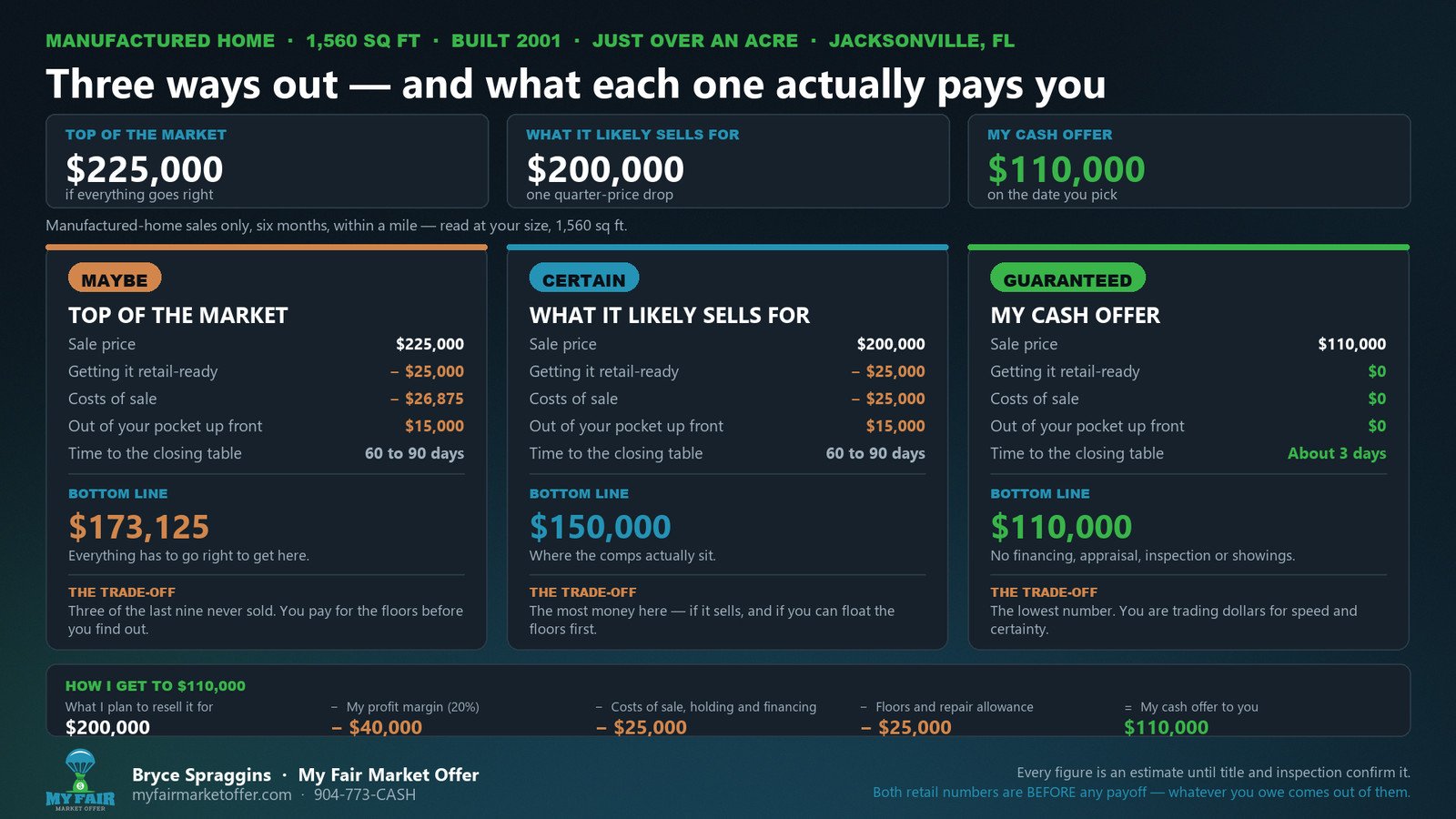
In a soft market the responsible way to price a house is to read the top of the market, round down to the nearest quarter price point, and then underwrite to one further $25,000 drop below that — because a seller who plans for the high number and sells at the low one has already lost the difference. On this Northside property, a 1,560 sq ft manufactured home on just over an acre, built in 2001, the comparable sales within a mile — manufactured homes only — put the top of the market around $230,000, which rounds down to $225,000. Allowing for one quarter-price drop gives $200,000, and that figure lands almost exactly on the fair market value line the comps themselves draw at this size. The cash offer is built off the lower number, not the higher one: $200,000 resale, less $40,000 profit, less $25,000 of front-end and back-end closing costs and four months of holding, less $25,000 of flooring and other repairs, giving a cash offer of $110,000. Of the nine manufactured homes that went to market here in six months, four closed and three never found a buyer at all — which is the risk the cash number is priced against.

Real Offers · Northside Jacksonville, off Garden Street

Why I price off the lower number, not the higher one

By Bryce Spraggins · October 2, 2026

Manufactured home · 1,560 sq ft · built 2001 · just over an acre

A 1,560 sq ft manufactured home on an acre on the Northside. Top of market reads $225,000, a soft market takes it to $200,000, and the cash offer built off that lower number is $110,000 — with every step of the subtraction shown.

The address and the homeowner's name are never shown. Everything else — the condition, the comps, and the number — is exactly what happened.

The offer and the market read

October 2, 2026

The full comp pull, the quarter-price drop, the subtraction down to $110,000, and the three choices put to the seller.

How This Number Was Built

This one is a 1,560 sq ft manufactured home on just over an acre on the Northside, built in 2001. The seller had Bryce out to the property, and the video is the market read he promised in return — not a pitch, a snapshot of where homes of this exact type are actually transacting right now.

The method matters more than the number. The comp pull was tightened to a one-mile radius and, critically, to manufactured homes only. That restriction is what makes the rest of the page trustworthy: a radius pull that quietly mixed in site-built houses would have handed back a far higher value and an offer built on sand. Nine manufactured homes went to market inside that radius in six months. Four closed. Three never found a buyer. One is still active and one is under contract.

Run through the pricing model, those sales put the top of the market at roughly $230,000 for a home this size. Bryce always rounds to the nearest quarter price point, and he rounds down — so the honest top-of-market retail number is $225,000. The market is soft right now, so he then counts on at least one quarter-price drop of $25,000, which lands at $200,000. That is not a pessimistic guess; it sits almost exactly on the fair market value line the comps themselves draw at 1,560 sq ft.

Then comes the part most cash home buyers will not show you. He underwrites the offer against the lower number, not the higher one, because that is the number that protects him if the market keeps softening. From $200,000 he subtracts $40,000 of profit, $25,000 of front-end and back-end closing costs plus four months of holding, and $25,000 of repairs — $15,000 to put the soft subfloor and floors right, and another $10,000 carried for whatever an end buyer negotiates. That leaves a cash offer of $110,000, payable in cash, closing on the seller date once title clears — normally about three days.

The video then does something unusual: it argues against its own offer. Bryce is also a licensed Realtor, and he lays out the listing path honestly, hassle and all. The floors have to be fixed before it can go on the market. A staging consultant comes through. The sellers and their dogs have to leave the house for every showing. Retail-ready takes two to three weeks, the market takes another 30 to 60 days, and the seller is at the closing table in 60 to 90 days rather than three days.

And he names a third option out loud, which almost nobody does: look at the cash number, look at what you would actually net listing it, and decide not to sell in this market at all. Three doors, all three on the table, with the arithmetic behind each one shown on camera.

The Actual Comps

These are the real charts this offer was priced from — not a re-creation.

Three ways out of the same property compared side by side, with what the seller nets under each
The three routes out, ordered by how certain each number is rather than how big it is. Top of the market is $225,000 and nets about $173,125, but everything has to go right and three of the last nine manufactured homes here never found a buyer. The likely sale at $200,000 nets about $150,000 — one quarter-price drop below the top, which is where the comps actually sit. The cash offer is $110,000, the lowest number on the page and the only guaranteed one. Both retail columns assume $15,000 out of pocket for the floors before it ever lists, and both are before any mortgage payoff. The band along the bottom shows the cash number being built: $200,000 resale, less $40,000 profit, less $25,000 of costs and holding, less $25,000 of floors and repair allowance. (Click to enlarge.)
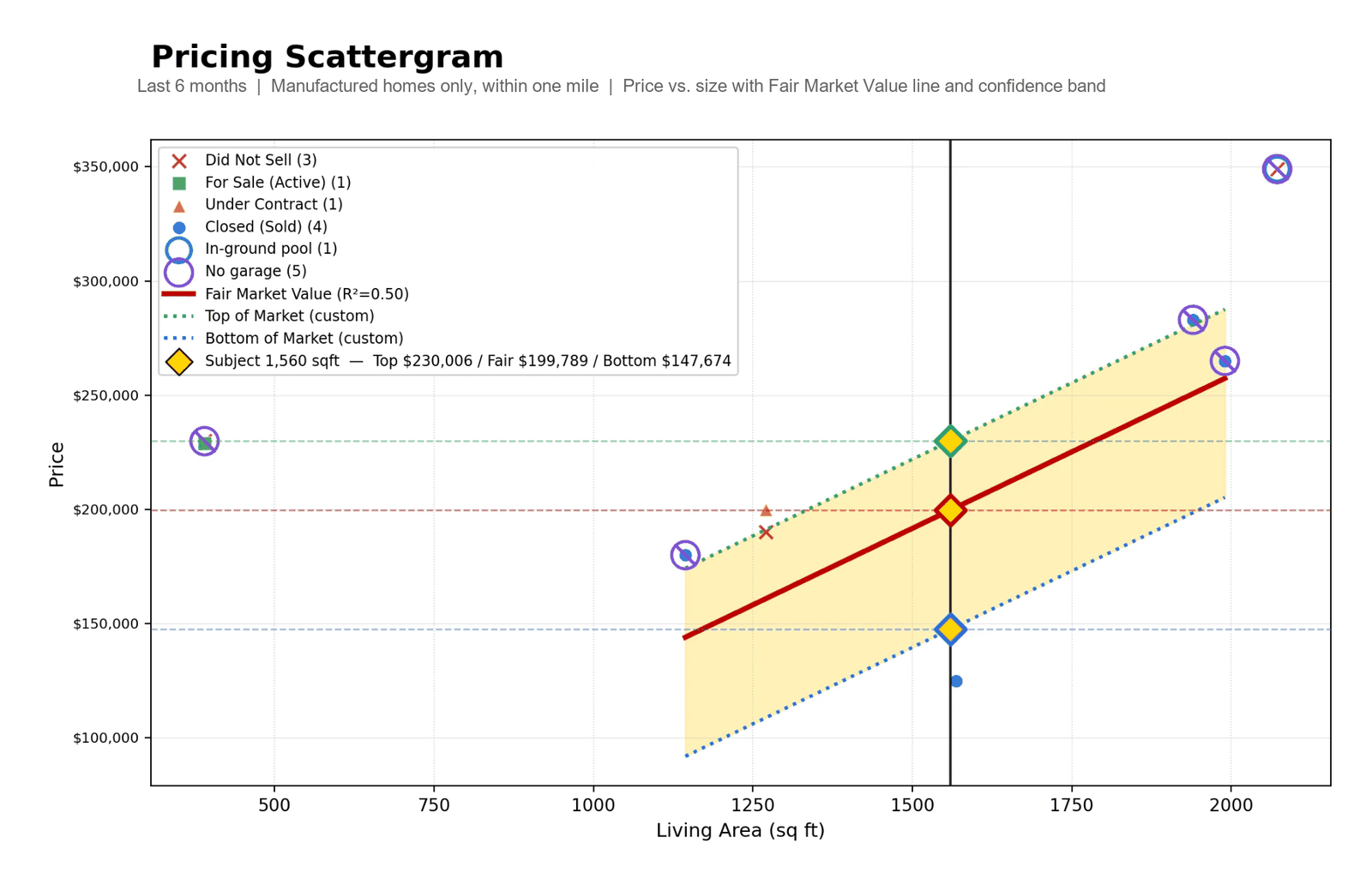
Scattergram of manufactured home sales within one mile over six months, price plotted against living area, with the subject property marked at 1,560 sq ft
Every manufactured home that went to market within a mile over six months, price against size. Nine properties: four closed, three never found a buyer, one is active and one is under contract. Read at the subject’s 1,560 sq ft, the three lines give Top of Market $230,006, Fair Market Value $199,789 and Bottom of Market $147,674. That top figure is where the $225,000 comes from — rounded down to the nearest quarter price point, never up — and one further quarter-price drop gives the $200,000 the cash offer is built from, which sits almost exactly on the fair value line. Be honest about the fit: R² is 0.50, so size explains only about half of what moves price here. That is normal on acreage, where the land carries a large share of the value, and it is why the smallest comp on the chart sits so far above the line. The subject does at least fall inside the range of real sales rather than being extrapolated past the edge of the data, which is what makes the read usable. (Click to enlarge.)

Common Questions

Why offer $110,000 on a home that could sell for $225,000?

Because $225,000 is the top of the market, not the likely sale price, and a cash offer has to be underwritten against the number that holds if the market softens further. Expected retail here is $200,000. From that comes $40,000 of profit, $25,000 of front-end and back-end closing costs plus four months of holding, and $25,000 of repairs — $15,000 to put the soft subfloor and floors right and $10,000 for whatever an end buyer negotiates. That arithmetic lands at $110,000. The seller trades the difference for certainty, no repairs, no showings and a closing date they pick.

Why round the top of market down instead of up?

Rounding down is what makes the rest of the estimate safe. The model put the top of this market near $230,000; rounding to the nearest quarter price point gives $225,000 rather than $250,000. A seller who plans around the higher number and sells at the lower one has already lost the difference, and every cost below the sale price is calculated as a percentage of it — so an inflated starting number inflates everything underneath it too.

Why do the comps have to be manufactured homes only?

Because a manufactured home and a site-built house of the same square footage do not sell for the same money, and they do not attract the same buyers or the same financing. A radius pull that mixes them returns a blended value that is too high for the manufactured home and too low for the site-built one. Restricting the comp set to manufactured homes inside one mile is what makes a $200,000 expected retail figure defensible rather than optimistic.

What does a seller actually net if they list it instead?

At $225,000 the net is about $173,125 before any mortgage payoff, and at $200,000 it is about $150,000 — after the listing side, the buyer agent, a budgeted buyer closing cost credit, the seller own closing costs, the flooring work and a repair negotiation allowance. Whatever is still owed to a lender comes out of that figure. Against a $110,000 cash offer that is real money, and it is the reason the listing option is presented rather than buried. What it costs is 60 to 90 days, money out of pocket for the floors before it lists, and the risk that it joins the three homes in six months that never found a buyer.

Is not selling a legitimate option?

Yes, and it is named explicitly at the end of the video. Once a seller has seen the cash number and what they would actually net listing it, deciding the market is not paying enough right now is a rational answer. A market read is worth having even when it ends in no sale — the point of the exercise is that the decision is made with the real numbers in front of you rather than a guess.

Related Resources

Want Your Own As-Is Cash Offer?

Tell us about the house and you'll get a real as-is cash offer to purchase your home — no repairs, no showings, no commissions. Same process, same honesty, and you'll hear the number out loud.