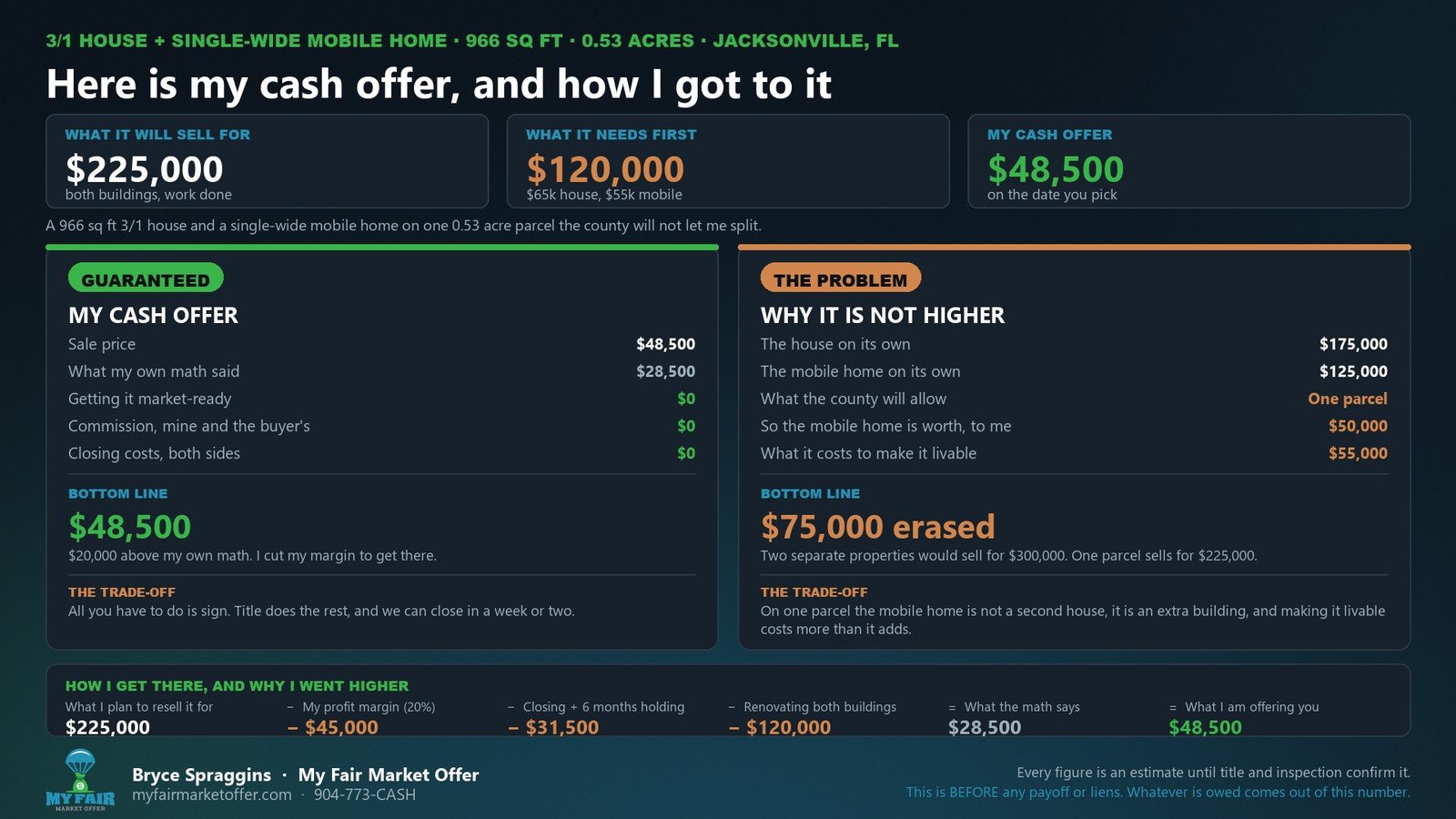
Two homes on one parcel are worth considerably less than the same two homes on two parcels. This Northwest Jacksonville property is a 966 sq ft 3 bed, 1 bath house with a single-wide mobile home beside it, both sitting on a single 0.53 acre lot. Split into two parcels and sold separately, the house would carry a retail price around $175,000 and the mobile home around $125,000 — $300,000 of resale. The city would not permit the split, so the mobile home stops being a second home and becomes an extra building on a lot that already has a house on it. On one parcel it adds only about $50,000 of value, putting total resale at $225,000. That single answer erased $75,000. It gets harder before it gets better: the mobile home needs roughly $55,000 of work to be retail ready, so it costs more to fix than it adds. Full renovation of both buildings — roofs on each, then a gut of floors, paint, kitchens and bathrooms — runs $120,000. After profit, front-end and back-end closing costs, a 3% buyer concession in a buyer’s market and six months of holding, the arithmetic produces a cash offer of $28,500. The offer actually made was $48,500 — $20,000 above his own math, by cutting the profit margin.

Real Offers · Northwest Jacksonville, on a main road off I-10

Two Homes on One Parcel Are Worth Less Than Two Parcels

By Bryce Spraggins · October 19, 2026

3 bed, 1 bath, 966 sq ft · plus a single-wide mobile home · both on one 0.53 acre parcel · the city would not allow a split

A 966 sq ft 3/1 house and a single-wide mobile home on one 0.53 acre parcel. Split, they are worth $300,000. The city said no, which took resale to $225,000 and erased $75,000. The math said offer $28,500. He offered $48,500.

The address and the homeowner's name are never shown. Everything else — the condition, the comps, and the number — is exactly what happened.

The offer, and the parcel split the city would not allow

October 19, 2026

Why two homes on one lot are worth $75,000 less than two lots, what one real comp can and cannot tell you, and the $28,500 model that became a $48,500 offer.

How This Number Was Built

This one is a 966 sq ft 3 bed, 1 bath house with a single-wide mobile home beside it, both on a single 0.53 acre parcel in Northwest Jacksonville. The seller had Bryce out to the property, and this video is the market read he promised in return.

It opens with a question most cash home buyers never bother to ask. Before pricing anything, Bryce went to the city to find out whether the parcel could be split in half and sold as two separate entities. That is the whole deal, because the answer changes the value enormously. Split, the house carries a retail price around $175,000 and the mobile home around $125,000. Two parcels, two buyers, two closings, $300,000 of resale, and a materially higher cash offer.

The city said no. On one parcel the mobile home is no longer a second home that someone can buy and own. It is an extra building on a lot that already has a house on it, and the only buyer who wants that is a buyer who wants both. Bryce is explicit about why that hurts: it does add value, but it considerably lowers the buyer pool, and fewer buyers means less competition, which drives the price down. So the mobile home goes in at an extra $50,000 on top of the $175,000 rather than its own $125,000, and total resale lands at $225,000. One answer from the city erased $75,000.

Then the part that makes this property genuinely difficult. Getting the mobile home into retail-ready shape costs about $55,000 — more than the $50,000 it adds. It is the rare piece of a deal that is worth less finished than it costs to finish, and leaving it alone is not really an option either, because a derelict single-wide beside a renovated house is its own problem at resale. The plan is a complete remodel of both buildings: a roof on each, then an effective gut job — floors, paint, kitchens and bathrooms — for $120,000 across the pair.

The comps are thin and the video says so rather than dressing it up. The pull returned two properties. One is still active and has not closed, which means it is not really a comp at all — an asking price is an opinion, not a sale. The other is a genuine closed sale: a 3/1 that sold for $189,000. Bryce prices the house at $175,000 rather than $189,000 because this one sits on a main road, and a main road is a deduction every time. One real comp, marked down for a known defect, stated out loud.

From $225,000 of resale comes $120,000 of renovation, his profit margin, front-end and back-end closing costs, at least 3% to the buyer to help them close — which he notes is simply what a buyer’s market costs — and six months of holding. That arithmetic produces $28,500, and he says plainly on camera: I know that’s low.

So he does not offer it. He says he thinks he can save on some of the renovation and that he is willing to cut his profit margin, and he offers $48,500 instead — $20,000 above the number his own model produced, with the model shown on screen so the seller can check the work.

The ending is the unusual part. Bryce is a licensed Realtor, and on every other property in this series he lays out the listing option as a real alternative. Here he talks the seller out of it: the property is not retail ready, it would need to be cleaned out and substantially renovated before it could be shown or staged, and putting that money in first is a risk the seller would be carrying alone. He names not selling at all as a legitimate third answer, and leaves it there.

The Actual Comps

These are the real charts this offer was priced from — not a re-creation.

The cash offer broken down beside the reason it is not higher, showing the parcel split that was refused
The offer and the reason it is not larger, side by side. The cash offer is $48,500, with no commission, no closing costs on either side, nothing spent getting the property market-ready and a closing date the seller picks. The second column is the arithmetic that caps it: the house is worth $175,000 on its own and the mobile home $125,000, which is $300,000 as two parcels — but the city would only allow one parcel, so the mobile home adds just $50,000 and costs $55,000 to make livable. $75,000 erased by a single zoning answer. The band along the bottom shows the whole build: $225,000 of resale, less $45,000 of profit, less $31,500 of closing and six months of holding, less $120,000 of renovation across both buildings, which lands at $28,500 — and then the offer actually made, $48,500, $20,000 above his own math. (Click to enlarge.)

Common Questions

Why is a mobile home on the same parcel worth so much less than one on its own lot?

Because on its own parcel it is a home someone can buy, finance and own. On a shared parcel it is an extra building on a lot that already has a house on it, and the only buyer who wants it is a buyer who wants both at once. That is a far smaller pool of buyers, and fewer buyers means less competition, which drives the price down. On this property the difference is stark: sold separately the mobile home would carry a retail price around $125,000, but on the shared parcel it adds only about $50,000 to the value of the whole. The split would have put total resale at $300,000. Without it, resale is $225,000.

Can you split a parcel in half and sell the two homes separately?

Sometimes, and it is always worth asking before anyone agrees on a price, because the answer can move the value by tens of thousands of dollars. It depends on the zoning, the minimum lot width and lot area for that zoning district, whether a replat is required rather than a simple administrative split, and critically where the existing buildings sit relative to the new line, because setbacks from a newly created property line can make a split impossible even when the lot is plenty big enough. On this property the city said no, and that single answer erased about $75,000 of value before any pricing conversation even started.

Why renovate the mobile home if it costs more to fix than it adds?

Because leaving it alone is not actually free. The work runs about $55,000 against roughly $50,000 of added value, so in isolation it loses money. But a derelict single-wide sitting beside a freshly renovated house is its own problem at resale. It affects what an appraiser says, what a lender will finance, and what a retail buyer is willing to pay for the house itself. The choice is not between spending $55,000 and spending nothing. It is between spending it and accepting a lower price on the whole property, and on this parcel the first option is the better of the two.

Is a single closed comparable sale enough to price a property?

It is thin, and the honest thing is to say so rather than hide it behind a chart. The pull here returned two properties. One is still active on the market and has not closed, which makes it an asking price rather than a sale, and an asking price is an opinion. The only genuine closed comparable is a 3 bed, 1 bath that sold for $189,000. The subject is priced at $175,000 rather than $189,000 because it sits on a main road, which is a deduction every time. When the comp set is this thin there is no scattergram on the page, because fitting a trend line through a single sale would imply a confidence the data does not support.

Why offer $48,500 when the math said $28,500?

Because the model is a tool, not a verdict. The arithmetic runs $225,000 of resale less $120,000 of renovation across both buildings, less the profit margin, less front-end and back-end closing costs, less at least 3% to the buyer to help them close in a buyers market, less six months of holding. That lands at $28,500, and he says on camera that he knows it is low. He believes he can save on some of the renovation and he is willing to take less profit, so he offered $48,500 instead, which is $20,000 above his own number. Showing both figures is the point. A seller who can see the model can check the work rather than take the offer on faith.

Why advise against listing it with a Realtor?

Because the property is not retail ready, and listing something that is not ready is how a seller loses money slowly. It would need to be cleaned out and substantially renovated before it could be shown, staged or photographed well, and that money would come out of the sellers pocket first, months before any closing. Bryce is a licensed Realtor and would normally present listing as a genuine alternative. Here he does not, because the only way it works is if the seller funds the renovation and carries the risk alone. Not selling at the moment is named as a legitimate third answer.

Related Resources

Want Your Own As-Is Cash Offer?

Tell us about the house and you'll get a real as-is cash offer to purchase your home — no repairs, no showings, no commissions. Same process, same honesty, and you'll hear the number out loud.