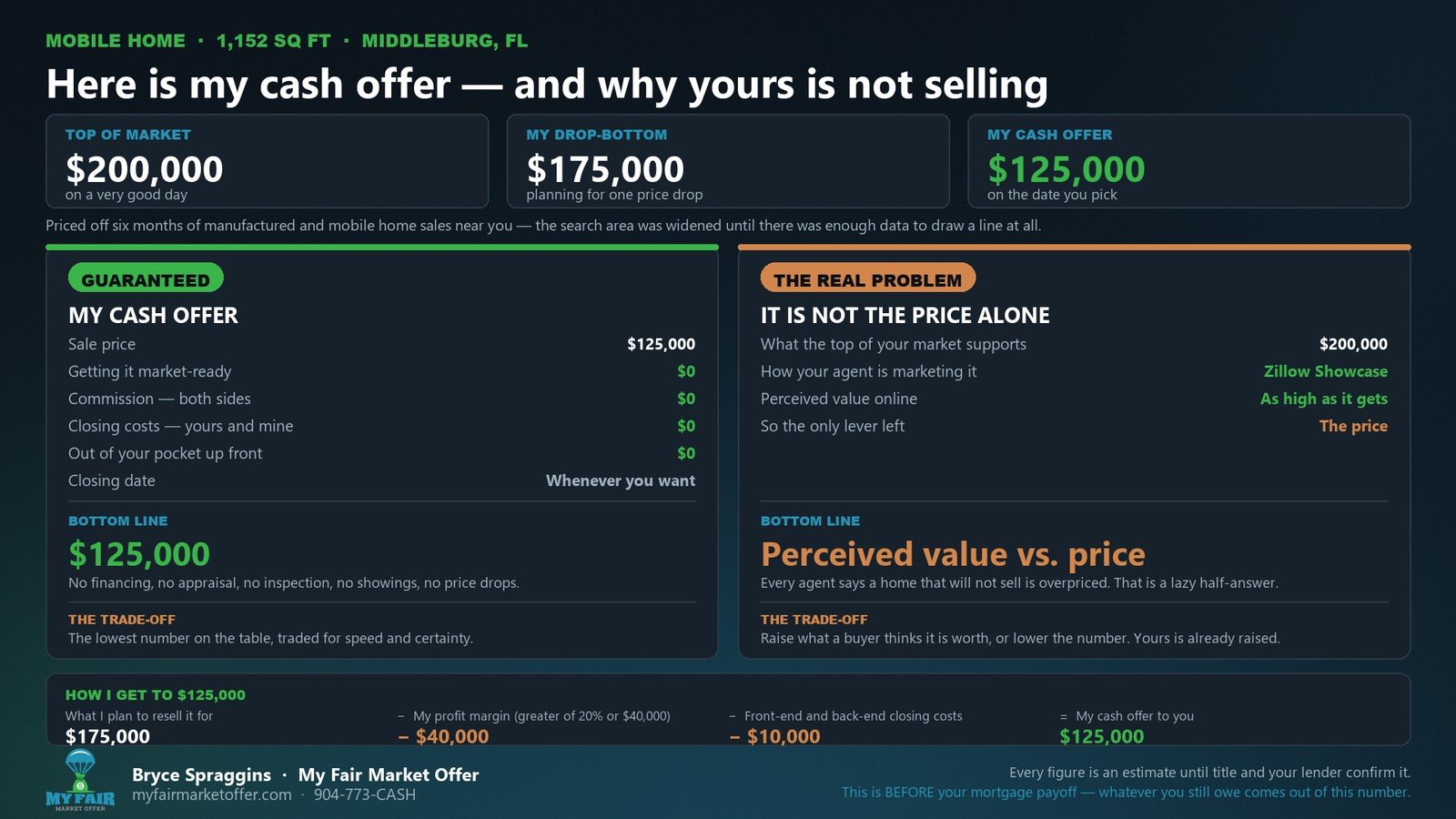
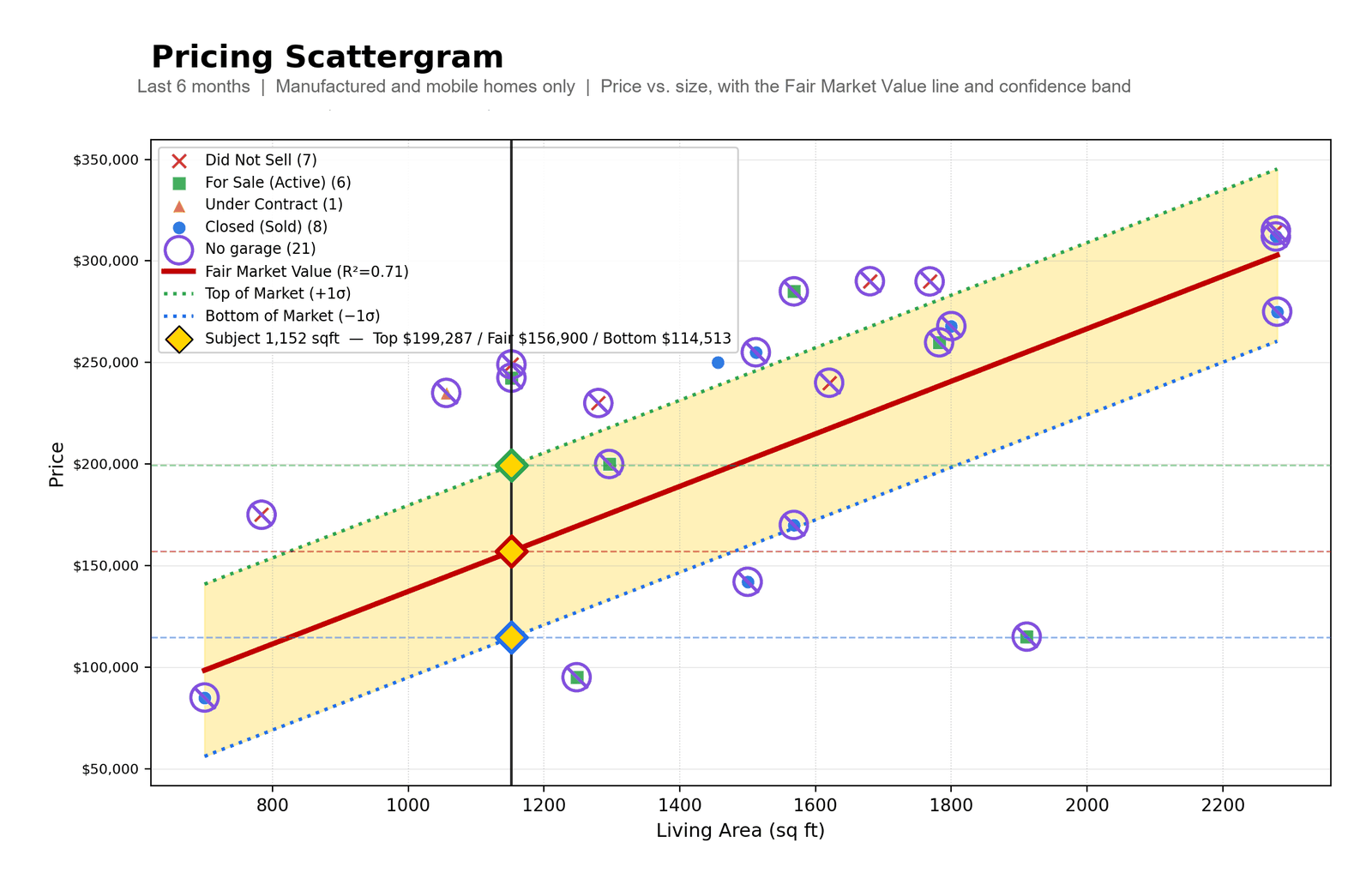
A home that will not sell is not automatically overpriced — the honest version is that its perceived value has fallen below its price, and a seller can fix that from either end. This 1,152 sq ft manufactured home in Middleburg, Clay County was already listed and sitting. Six months of manufactured and mobile home sales nearby put the top of its market at $199,287 and fair market value at $156,900, against a very wide confidence band of plus or minus $42,387. The listing agent was already doing the work — professional marketing, paid Zillow Showcase placement — so the perceived value was close to maxed, which left price as the only remaining lever. The as-is cash offer was $125,000: a $175,000 resale plan minus the $40,000 profit floor that governs small deals and about $10,000 in front-end and back-end closing costs. The seller was advised to keep listing and step the price down rather than take the cash offer.
Real Offers · Middleburg, Clay County
1,152 sq ft manufactured home · priced off six months of manufactured and mobile home sales nearby
A manufactured home sitting on the market in Middleburg. Why "it's the price" is a lazy answer, what perceived value actually means, the scattergram behind a $200,000 top of market, and a $125,000 cash offer.
The address and the homeowner's name are never shown. Everything else — the condition, the comps, and the number — is exactly what happened.
Why "it's the price" is a lazy answer, what perceived value really means, reading a thin manufactured-home market, and a $125,000 cash offer the seller was advised not to take.
This one is already listed. The seller has an agent, the agent is doing the job properly, and the house is still sitting. So the video is less about the cash offer than about the reason nothing is happening — and the reason is not the one the industry gives by reflex.
The lazy answer, and the honest one. Ask any agent why a home is not selling and you will hear “it’s the price.” That is true often enough to be useful and lazy enough to be wrong. The accurate version is that perceived value has fallen below the price. Those are two different numbers with two different fixes: raise what a buyer believes the home is worth, or lower what you are asking. A seller who only ever hears “drop the price” is being handed one of the two levers.
In this case one lever is already pulled all the way. The listing agent is paying for Zillow Showcase — premium placement that is above and beyond what most listings get — and the marketing presents the home well. That is the perceived-value side handled about as far as it can be handled from a desk. The one caveat given on camera: the home has to show in person the way it shows online. If the photography is doing work the property does not back up on a walkthrough, perceived value collapses at the front door and no amount of placement fixes it.
What the comps say. Manufactured and mobile homes are thin data, and the search area had to be widened before there was enough to draw a line at all — that is worth saying plainly rather than presenting a tidy chart as though it were dense. Six months of sales and attempted sales put a 1,152 sq ft home at a fair market value of $156,900 and a top of market of $199,287. The R² is 0.71, so size explains most of the spread but not all of it. The confidence band is plus or minus $42,387 — about 27 percent either side — which is very wide, and it means the difference between a good outcome and a poor one on this property is larger than the usual quarter-point rounding suggests.
The retail plan. Two hundred thousand on a good day. Planning for one $25,000 price drop puts the working number at $175,000. Both figures sit above the fair market line and below the top of the band, which is the honest place to put them on a property where the band is this wide.
And the market itself is not the problem. Over the last twelve months this segment ran a 66 percent chance of selling with about 2.9 months of inventory and a median of $144 per square foot. Under three months of inventory is a seller’s market. Homes here are moving. That removes the comfortable excuse and puts the question back on this specific listing.
The cash offer, built in the open. Start at the $175,000 resale plan. Take out the profit margin — the greater of 20 percent or $40,000, and on a deal this size the $40,000 floor governs because 20 percent would only be $35,000. Take out about $10,000 in front-end and back-end closing costs. That lands at $125,000, closing on whatever date the seller picks.
The advice was not to take it. A cash offer at $125,000 against a home the market will pay closer to $175,000 for is a trade of dollars for speed, and this seller does not obviously need the speed — he has a working listing and a competent agent. The recommendation on camera was to stay listed and step the price down until it meets the market. That is the whole point of running the numbers out loud: sometimes they say do not sell to me.
These are the real charts this offer was priced from — not a re-creation.
Because price is only half of the equation. What actually stalls a listing is perceived value falling below the asking price — and perceived value is built by photography, presentation, placement and how the home shows in person. “It’s the price” is the answer most sellers get because it is the easiest lever to pull, but a seller has two: raise what buyers believe the home is worth, or lower what you are asking. If the marketing is already excellent and the home shows as well in person as it does online, then perceived value is maxed and price genuinely is the only thing left.
It raises perceived value, which is one of the two things that has to move for a stuck listing to sell. Showcase placement gives a listing premium presentation and more visibility than a standard one, and an agent paying for it is spending beyond the ordinary marketing budget. What it cannot do is close the gap on its own. If the asking price sits above what comparable sales support, better placement puts a well-presented listing in front of more people who still will not pay the number.
The same way as any home — against closed sales of similar properties, plotted against size — but the data is much thinner, so the search area usually has to be widened before there is enough to draw a trend line. That widening costs accuracy: on this property the confidence band came out at plus or minus $42,387 around a fair market value of $156,900, roughly 27 percent either side. A wide band does not make the valuation useless, but it does mean the difference between pricing well and pricing badly is bigger than on a conventional subdivision home.
It is how long it would take to sell every home currently for sale at the current rate of sales, and it is the cleanest single read on whether buyers or sellers hold the leverage. Under about three months favours sellers; five to six is roughly balanced; above that favours buyers. The manufactured home segment around this property ran about 2.9 months of inventory with a 66 percent chance of selling over the last twelve months, which means homes there are transacting. When the market reads like that and a specific listing is not moving, the explanation is the listing rather than the conditions.
Because a cash offer is a trade of money for speed and certainty, and not every seller needs that trade. This seller already had a working listing with a competent agent in a market with under three months of inventory, so the honest recommendation was to stay listed and step the price down toward what the comparable sales support rather than accept $125,000 against a home the market will likely pay closer to $175,000 for. A cash offer earns its discount when the seller needs a date, a guarantee, or an exit from a property that will not sell on the open market.
Tell us about the house and you'll get a real as-is cash offer to purchase your home — no repairs, no showings, no commissions. Same process, same honesty, and you'll hear the number out loud.
Bryce will be there. You'll receive a calendar invite shortly.