When a house is worth less than the loan against it, the cash offer stops being the question. This one is 1,887 sq ft, it is in foreclosure, and the amount filed in the case is about $183,000. In its current condition it is worth roughly $170,000, which is established by five houses in the same subdivision that sold twice, once in this condition and once rebuilt. The three closest in size sit at $85 to $91 a square foot as is. Renovated it would list around $225,000 after a planned price drop, and after a $80,000 renovation, the costs of sale, the holding and the money, the cash offer is $90,090. None of those numbers pays the loan off. Listing it as is at an optimistic $175,000 still leaves the lender about $26,813 short, and the cash offer leaves them $92,910 short. So every road here runs through the lender’s loss mitigation department, and the honest advice on camera was to find out what they will approve before deciding anything.

Real Offers · Arlington, Jacksonville, in the Oakwood Villa Estates area

The House Is Worth Less Than the Debt

By Bryce Spraggins · November 12, 2026 · Seller chose another route

1,887 sq ft · single family · in foreclosure, with about $183,000 filed as the claim · needs roughly $80,000 of work · worth about $170,000 in its current condition

A 1,887 sq ft house in foreclosure with about $183,000 owed and roughly $170,000 of value in its current condition. The cash offer was $90,090, and none of the three ways out pays the loan off.

The address and the homeowner's name are never shown. Everything else — the condition, the comps, and the number — is exactly what happened.

The house is worth less than the loan against it

November 12, 2026

About $183,000 filed in the foreclosure against roughly $170,000 of value. The cash offer is $90,090, an as-is listing is maybe $175,000, and all three need the lender to forgive the difference.

How This Number Was Built

This one is different from every other offer in this series, because the arithmetic stops mattering about halfway through. The house is 1,887 sq ft, it is in foreclosure, and the claim filed in the case is about $183,000. In the condition it is in today, it is worth less than that. Once that is true, the cash offer is no longer the decision in front of the owner. The lender is.

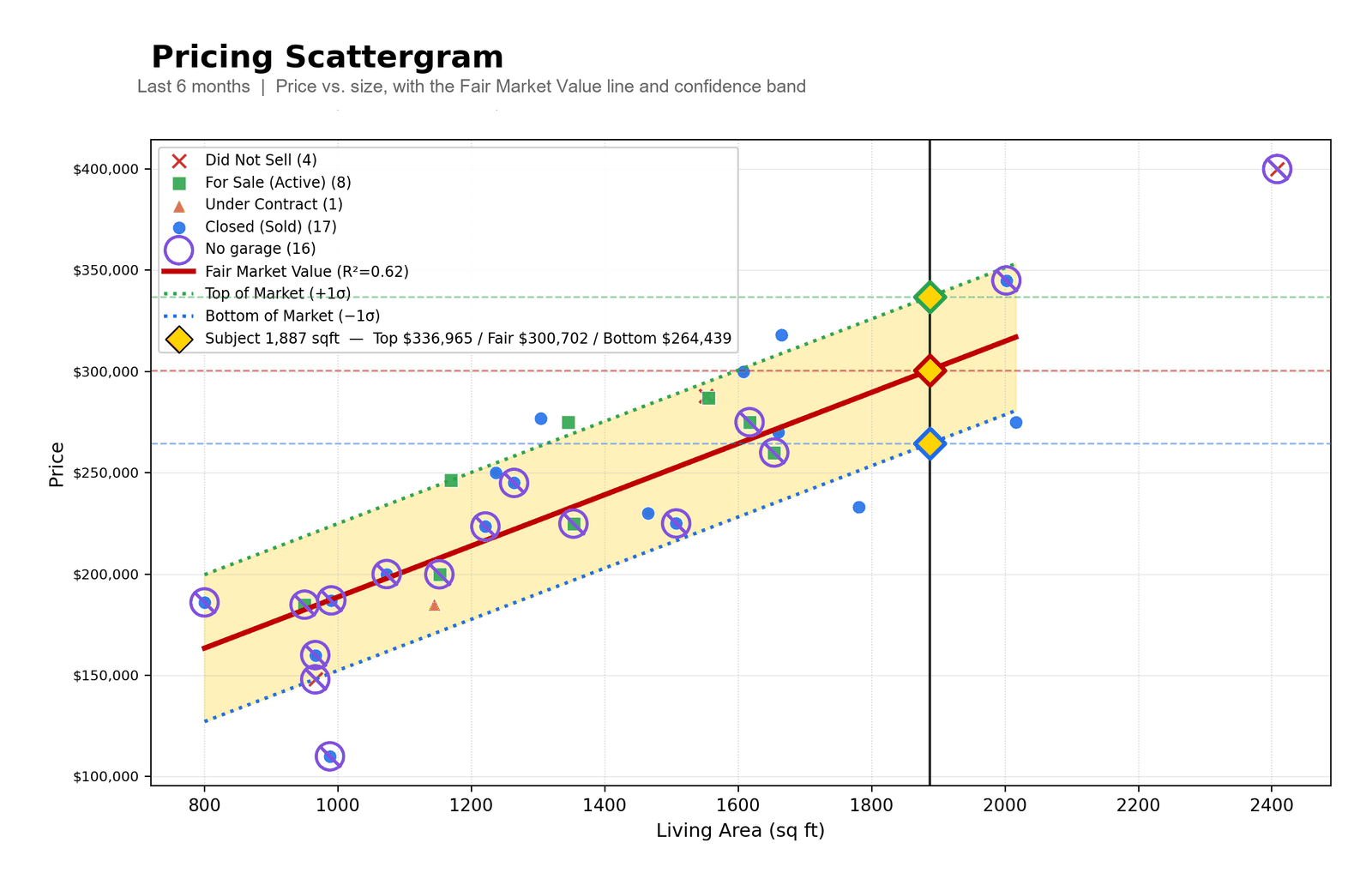
The market read came first, and it was hyperlocal. Ninety records inside this one neighborhood, 52 of them closed sales, plotted against living area on a scattergram with a fair market value line and a band either side of it. At 1,887 sq ft that chart reads a top of market around $336,965, a fair value near $300,702 and a bottom of market at $264,439. Those are renovated numbers. They describe a house that has already had the work done.

This chart is worth more than most of them, and that is worth saying. The fit here is R² 0.62, meaning size explains about sixty percent of the price difference between these homes, and the subject sits comfortably inside the range of the comps rather than off the end of it. On plenty of neighborhoods in this series the line is nearly flat and proves nothing. Here it works.

Then the condition. The house needs about $80,000 of work. The working resale is $225,000, which is the bottom of the band with one price drop built in before the sign ever goes up, because a third of the listings in this neighborhood never sell at all. Back out the renovation, the costs of sale, the holding and the cost of the money, and the cash offer is $90,090.

And here is where it stops being a normal offer. $90,090 against $183,000 owed is a $92,910 gap. Nobody can accept that without the lender agreeing to take less than they are owed, which is a short sale, and only the lender can approve one.

So the real question became what the house is worth as it sits. That number is not a guess here. Five houses in this same subdivision sold twice inside the data: once in rough condition, and again after somebody rebuilt them. One of them sold as is at $180,000 in May and again at $345,000 in October, five months apart. Another went $155,000 to $290,000. A third, $205,000 to $355,000. The three closest in size to this house put as-is value at $85 to $91 a square foot, which on 1,887 sq ft is about $160,000 to $173,000.

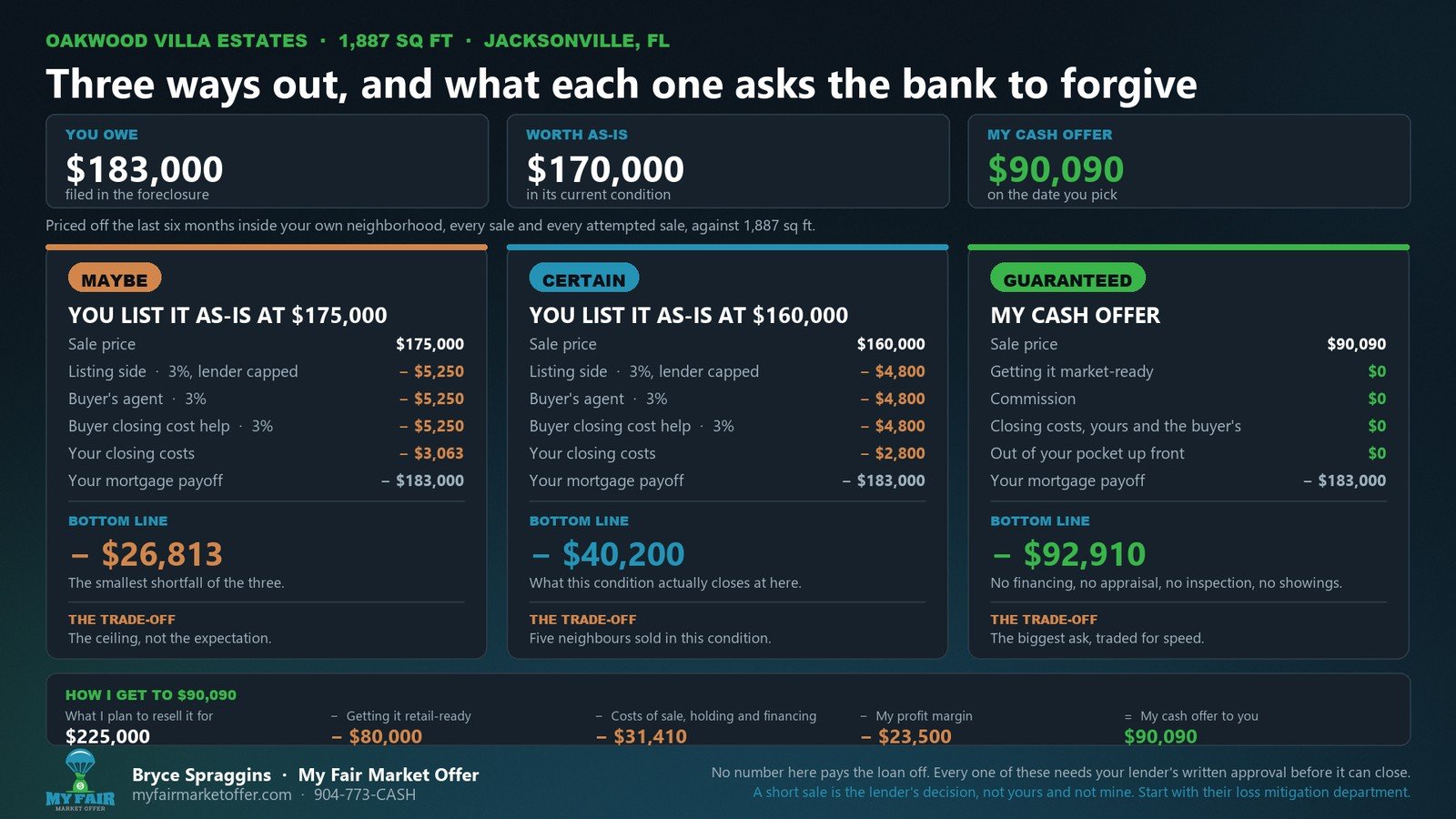
Which means even the optimistic version does not clear the debt. Listed as is at a stretch price of $175,000, after a commission the lender has to approve and the normal costs of sale, it still lands around $26,813 short of the payoff. At a realistic $160,000 it is about $40,200 short. The cash offer is $92,910 short. Three ways out, three shortfalls, and the smallest of them is the slowest.

The advice on camera was not to take the cash offer. It was to call the loss mitigation department of the mortgage company and find out what they will actually approve, because that answer governs everything else. And the offer to list it was taken off the table too, honestly: on a short sale the lender caps the commission, usually at three percent, and three percent of a $175,000 sale does not reach the minimum commission this brokerage charges. So the referral went to a short sale specialist instead.

The offer stands at $90,090 if the lender will approve it. No financing, no appraisal, no inspection, nothing to fix, and the closing date is the seller’s. But it is the largest thing to ask a bank to forgive out of the three, and the video says that out loud rather than leaving the owner to work it out later.

The Actual Comps

These are the real charts this offer was priced from — not a re-creation.

Three ways out of a 1,887 sq ft house in foreclosure, each one ending in a negative net because the mortgage payoff of $183,000 exceeds all three sale prices
Three ways out, and what each one asks the bank to forgive. Every column ends below zero, which is the whole point: with $183,000 owed against roughly $170,000 of value, nobody is getting paid and the only variable is the size of the shortfall. An as-is listing at a stretch $175,000 asks for about $26,813. A realistic $160,000 asks about $40,200. The cash offer asks for $92,910, the most of the three. Note the listing columns run 3% a side rather than the usual stack, because on a short sale the lender approves and caps the commission. (Click to enlarge.)
Pricing scattergram of a Jacksonville neighborhood plotting price against living area, with a fair market value line, a confidence band, and the subject home at 1,887 square feet
The renovated numbers, and a chart that actually works. Every sale and every attempted sale in the neighborhood over six months, plotted against living area. At 1,887 sq ft the lines read top of market $336,965, fair value $300,702 and bottom of market $264,439. The fit is R² 0.62 and the subject sits inside the range of the comps, so unlike many of these charts the line is worth reading. ⚠️ These are all renovated values. This house is not. (Click to enlarge.)
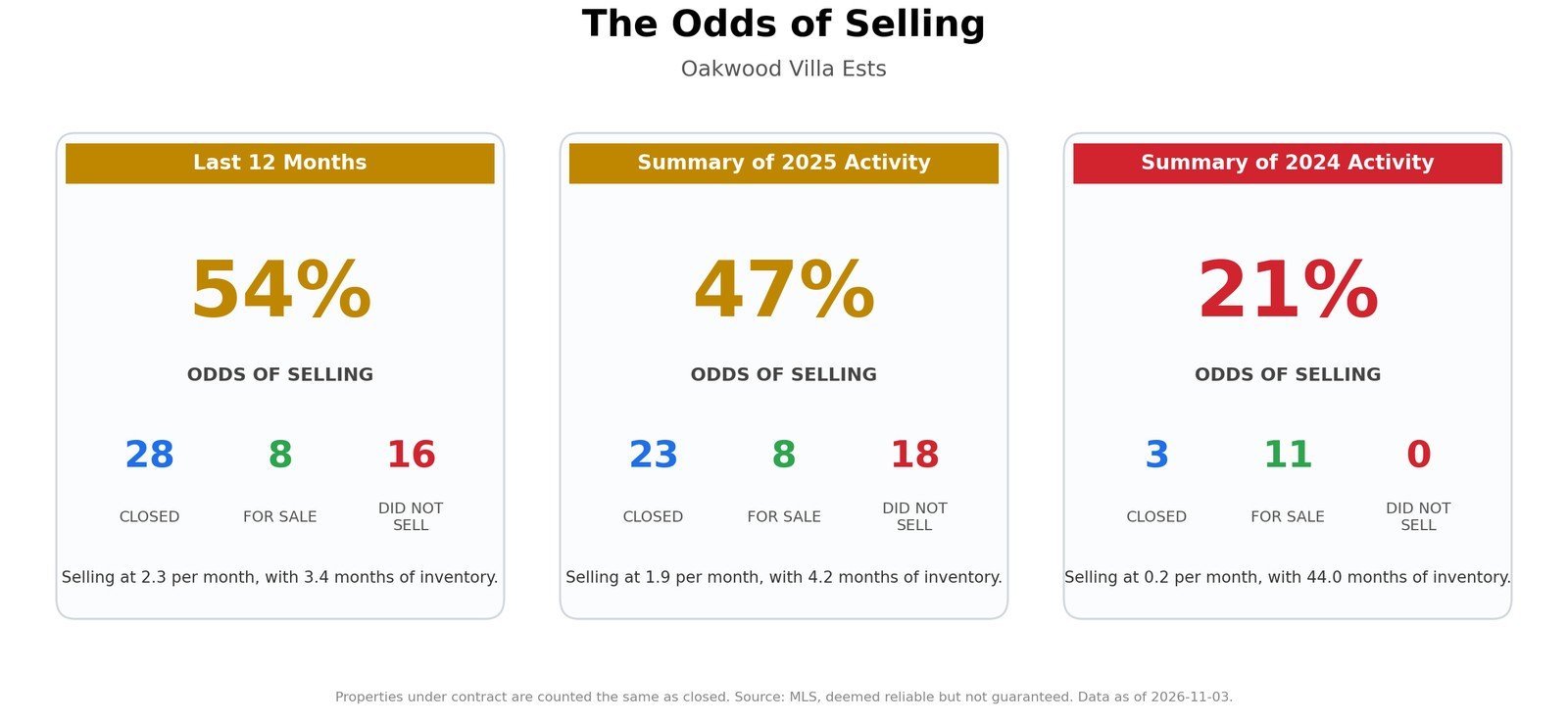
Odds of selling chart for a Jacksonville neighborhood showing 54 percent odds over the last twelve months, with 28 closed sales and 16 listings that never sold
Why a price drop is budgeted in before the sign goes up. Over the last twelve months 28 homes closed here and 16 never sold at all, with 3.4 months of standing inventory. Better than a third of the attempts fail. ⚠️ Read left to right, the odds have been improving, from 21% in 2024 to 47% in 2025 to 54% now. The market is hard on sellers, not getting harder. (Click to enlarge.)

Common Questions

What happens when a house is worth less than the mortgage on it?

The sale stops being the owner's decision alone and becomes the lender's. A seller cannot convey clear title without paying the loan off, so if the house will not fetch enough to do that, the lender has to agree in writing to accept less than they are owed. That agreement is a short sale. Until the lender approves one, no offer at any price can actually close. On this house about $183,000 was filed as the claim in the foreclosure and the house is worth roughly $170,000 in its current condition, so every possible exit, including listing it on the open market, runs through the same approval.

How do you work out what a house is worth in its current condition?

The strongest evidence is a house that sold twice: once in rough shape and once after somebody renovated it. The as-is leg of that pair is a comparable sale nobody can argue with, because it is the same house, the same street and the same market. In this neighborhood five houses did exactly that inside the data. One sold as is at $180,000 in May and again rebuilt at $345,000 in October. Another went $155,000 to $290,000, a third $205,000 to $355,000. Taking only the three closest in size to the subject gives an as-is range of $85 to $91 a square foot, which on 1,887 sq ft is about $160,000 to $173,000.

Why would a Realtor turn down a short sale listing?

Because on a short sale the lender approves the commission along with everything else, and they cap it, usually at three percent to the listing side. Three percent of a $175,000 sale is $5,250. A brokerage with a fixed minimum commission above that number cannot take the file without working below its own floor, and pretending otherwise would mean asking the lender to approve something they routinely decline. The honest answer is to say so and refer the seller to an agent who specialises in short sales and is set up to work at those numbers, which is what happened here.

Is a cash offer better than a short sale listing when the house is underwater?

Not automatically, and on this house it was not. The cash offer was $90,090, which asks the lender to forgive about $92,910. An as-is listing at an optimistic $175,000 asks them to forgive about $26,813, and a realistic $160,000 asks about $40,200. The smaller the shortfall, the more likely the lender approves it, so the listing is the stronger application even though it is slower and less certain. What a cash offer buys in this situation is speed and a closing date the seller picks, not a better outcome for the lender.

What is loss mitigation and why start there?

Loss mitigation is the department inside a mortgage servicer that handles borrowers who are behind, and it is the only part of the company that can approve a short sale, a loan modification, a repayment plan or a deed in lieu. Every other conversation about the house is downstream of what they will allow. Each lender has its own package, its own qualifying criteria and its own timeline, so the first useful step for a homeowner in foreclosure is to call them and ask what they permit and what they need, before committing to any offer or any listing.

How accurate is a pricing scattergram?

It depends entirely on the fit, and that number should always be checked before anyone leans on the line. The R-squared says how much of the price difference between homes is explained by size. On this neighborhood it came back at 0.62, which is strong, and the subject sat well inside the range of the comparable sales rather than off the end of them, so the line and the band either side of it are both meaningful. In other neighborhoods the same chart has come back at 0.03, where size explains almost nothing and the only honest read is the spread of the dots rather than the position of any one home against the line.

Does a foreclosure filing amount equal the payoff?

Not exactly. The figure filed in a foreclosure complaint is the amount claimed as of the filing date, and it generally includes unpaid principal, accrued interest, late charges and the fees incurred up to that point. Interest keeps accruing and legal fees keep accumulating while the case runs, so the real payoff on the day of closing is usually higher than the number in the complaint. For planning purposes that means a shortfall estimated off the filed claim is the optimistic version, and the actual gap the lender is asked to forgive tends to grow the longer the case goes on.

Related Resources

Want Your Own As-Is Cash Offer?

Tell us about the house and you'll get a real as-is cash offer to purchase your home — no repairs, no showings, no commissions. Same process, same honesty, and you'll hear the number out loud.