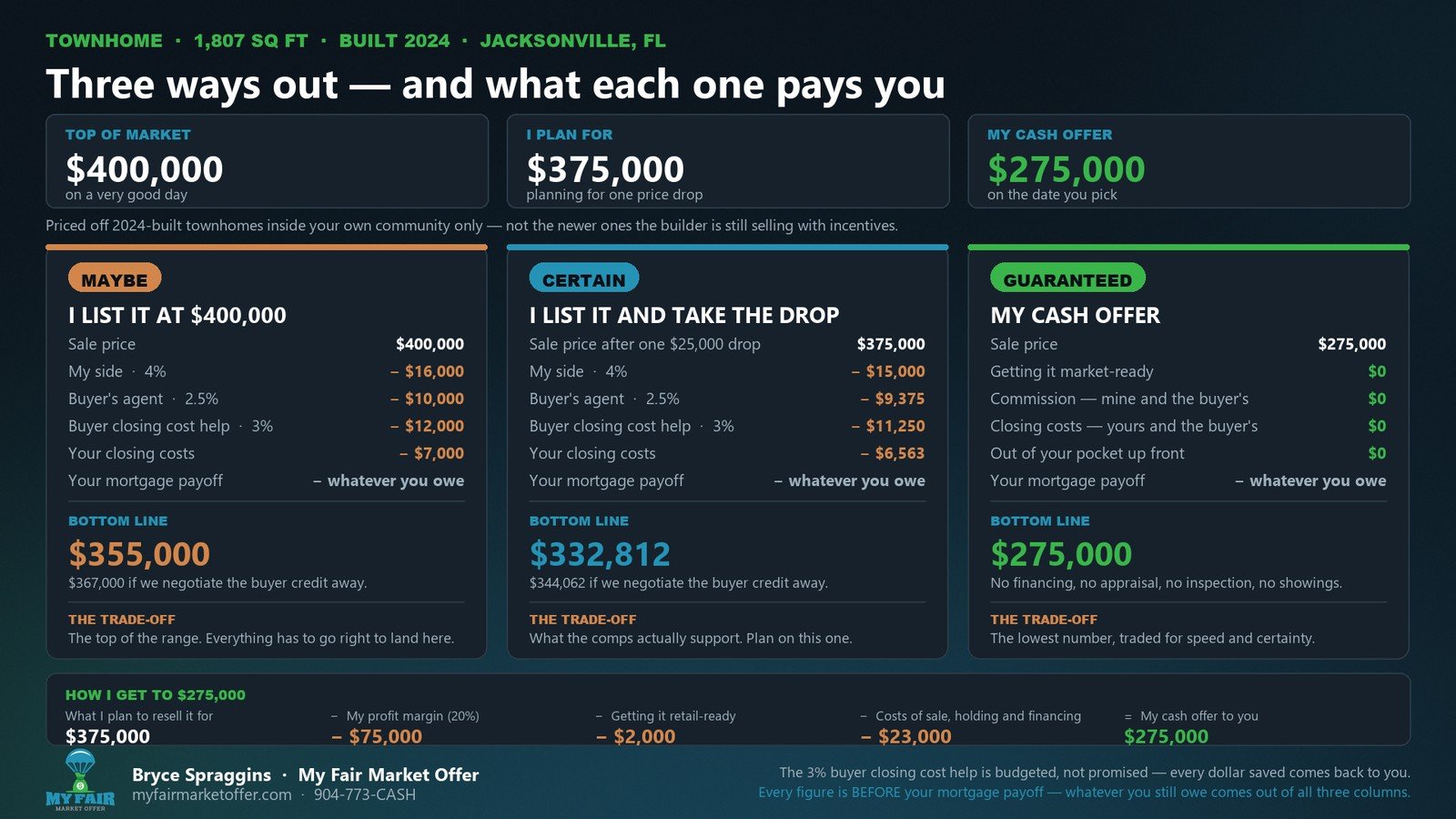
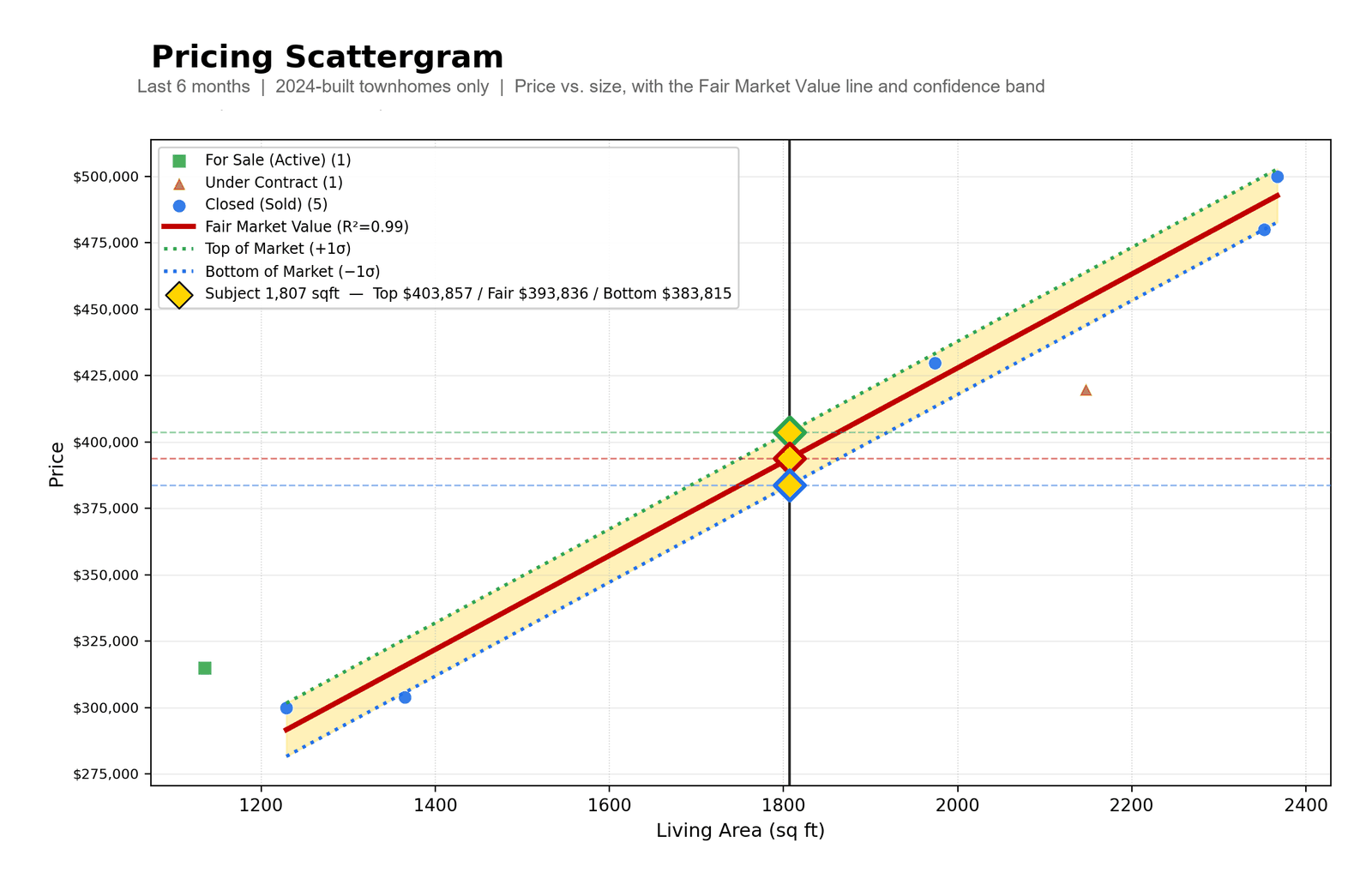
A home bought new in 2024 can be worth less than its owner paid two years later, because the builder is often still selling comparable new units nearby with incentives that a resale cannot match. On this 1,807 sq ft Jacksonville townhome, six months of sales and attempted sales among 2024-built townhomes only put fair market value at $393,836 and top of market at $403,857. Rounded down to the nearest quarter point that is a $400,000 list price, with one planned $25,000 price drop to $375,000 to actually move it. The as-is cash offer was $275,000: the $375,000 resale plan minus a 20 percent profit margin, $2,000 to make it retail-ready, and about $23,000 in costs of sale, holding and financing. Listing it instead nets roughly $332,812 to $355,000 before any mortgage payoff — so against a 2024 purchase price and two years of mostly-interest payments, both exits can still lose the owner money.

Real Offers · Southside Jacksonville

She Bought It New in 2024. Every Way Out Loses Money.

By Bryce Spraggins · September 18, 2026

1,807 sq ft townhome · built 2024 · priced off 2024-built townhomes only, not the builder’s newer inventory

A townhome bought new in 2024, now worth less than it cost. The hyperlocal scattergram, why the builder's newer inventory was excluded, what a listing actually nets, and a $275,000 cash offer.

The address and the homeowner's name are never shown. Everything else — the condition, the comps, and the number — is exactly what happened.

The Offer

September 18, 2026

The 2024-built-only comp pull, a scattergram that fits almost perfectly and why, what a listing really nets, why a wrap does not work at a 7 percent rate, and a $275,000 cash offer.

How This Number Was Built

This is not a distressed seller and it is not a tired house. It is someone who bought a brand new townhome two years ago, asked for a cash offer, and is going to hear that every road out of it costs her money. The video exists to show her exactly how much, using only the sales of homes identical to hers.

The comp pull is the whole trick here. The obvious mistake would be to price this against everything selling in the area — including the units the builder is still putting up and still discounting. Those are not competition on equal terms: a builder can buy down an interest rate and throw in options in a way a private resale simply cannot. So the pull was narrowed to 2024-built townhomes only, inside the same community, over the last six months. Seven data points: five closed sales, one under contract, one still for sale.

The line fits almost perfectly, and that is unusual. The R² on this scattergram is 0.99. On a normal pull that number sits near 0.5, because condition explains as much of the price as size does. Here every comparable is two years old, built by the same builder to the same finish level, so size really is the only variable left — which is why the trend line is this tight. That cuts in both directions. It makes the valuation unusually reliable, and it also means there is no “but mine is nicer” argument available to anyone on this street, in either direction.

What it says she is worth. At 1,807 sq ft the subject reads a fair market value of $393,836, a top of market of $403,857 and a bottom of $383,815. The subject sits in the middle of the comp range rather than off the end of it, so none of that is extrapolated. Rounded down to the nearest quarter point: list at $400,000, and in this market plan on one $25,000 price drop to $375,000 to actually get it done. Four hundred on a good day, three seventy-five on a bad one.

What a listing actually pays her. Getting $375,000 is not keeping $375,000. The listing side, the buyer’s agent, help with the buyer’s closing costs and her own closing costs come off the top. At $400,000 that leaves about $355,000; at $375,000 it leaves about $332,812. Both figures are before her mortgage payoff, and that is the part that decides everything. Two years into a new-build loan, almost every dollar paid so far has gone to interest rather than principal, so the payoff is close to what she borrowed.

The cash offer, built in the open. Start at the $375,000 resale plan. Take out a 20 percent profit margin, about $2,000 to make it retail-ready, and roughly $23,000 in costs of sale, holding and financing on the way back out. That lands at $275,000, closing on whatever date she picks, with nothing to fix, clean or show.

And the option that got explored and rejected on camera. Selling on a wrap — a buyer taking over her existing payments — only works when the existing interest rate is well below what a buyer could get on their own. Rates when she closed in 2024 were around 7 percent, which is no better than what a buyer can borrow at today. There is nothing below market to sell, so the wrap is not a real door on this one. It is worth saying out loud rather than quietly leaving it off the list.

The honest ending. Retail loses her money. Cash loses her more. If she can hold it, holding it is the recommendation — and that is the advice even though it is the one that pays nobody. If she genuinely has to sell, both doors are open and both numbers are on the table.

The Actual Comps

These are the real charts this offer was priced from — not a re-creation.

Offer summary comparing a $400,000 listing netting $355,000, a $375,000 listing netting $332,812, and a guaranteed $275,000 cash offer, with a band showing how the cash offer is built
The three ways out, each carried down to what she actually keeps. Columns are ordered by how sure the number is rather than how big it is — maybe at $400,000, certain at $375,000 after one planned price drop, guaranteed for the cash offer. Every column ends with the same line: your mortgage payoff comes off all three, which on a 2024 purchase is close to the full amount borrowed. The band across the bottom is the whole bridge from the $375,000 resale plan to the $275,000 offer. (Click to enlarge.)
Pricing scattergram of 2024-built townhomes showing five closed sales, one under contract and one active listing, with an R-squared of 0.99 and the 1,807 sq ft subject marked at a fair market value of $393,836
Six months of sales and attempted sales among 2024-built townhomes only, plotted against square footage — the builder’s newer inventory is deliberately excluded. The subject is the vertical line at 1,807 sq ft with three diamonds on it: top of market $403,857, fair market $393,836, bottom $383,815. The R² is 0.99 because these units are near-identical — same builder, same age, same finishes — so size is effectively the only variable. The subject sits mid-range rather than off the end, so nothing here is extrapolated. (Click to enlarge.)

Common Questions

Why is my new construction home worth less than I paid for it?

Usually because the builder is still selling. A builder with standing inventory can buy down a buyer’s interest rate, include options and cover closing costs in a way a private resale down the street cannot match, so the new units next door set the ceiling and the resale competes underneath it. On top of that, the price paid for a new home often includes upgrades and lot premiums that do not come back on a resale. It usually takes several years of appreciation before a new build catches back up to what its first owner paid.

Should I compare my home to the new ones the builder is still selling?

No. Compare it to resales of homes like yours, built in the same year, in the same community. Builder inventory is not a fair comparable because the builder can offer incentives a private seller cannot, and because a brand new unit with a warranty is a different product from a two-year-old one. On this property the comp pull was narrowed to 2024-built townhomes only, which produced seven sales and attempted sales in six months — enough to price it without ever referencing the builder’s current inventory.

What does an R-squared of 0.99 mean on a pricing scattergram?

It means square footage explains almost all of the difference in price between the comparable homes, so the trend line can be trusted closely. That is rare. On a typical neighborhood pull the R-squared sits nearer 0.5, because condition, updates and finish level explain as much of the price as size does. A figure this high usually indicates near-identical homes — same builder, same age, same finish level — which is exactly the case here. The practical consequence is that nobody in that community can argue their unit is worth meaningfully more than the line says because it is nicer.

Can I sell my house by letting the buyer take over my payments?

Only when your interest rate is well below what a buyer could get on their own, because the below-market payment is the entire product being sold. A seller who closed in 2024 is typically holding a rate around 7 percent, which is no better than what a buyer can borrow at today, so there is nothing to sell and a wrap or subject-to deal does not attract anyone. The structure works well for sellers holding loans from 2020 and 2021 at 3 percent. It also leaves the original loan in the seller’s name, which carries its own risks.

What do I actually walk away with if I list my house?

The sale price minus the listing side, the buyer’s agent, any help you give the buyer with their closing costs, your own closing costs, and then your mortgage payoff. On this townhome a $400,000 sale left roughly $355,000 and a $375,000 sale left roughly $332,812, both before the payoff. If you bought recently, the payoff is close to what you borrowed, because the early years of a mortgage are almost entirely interest — which is how an owner who has never missed a payment can still bring money to the closing table.

Related Resources

Want Your Own As-Is Cash Offer?

Tell us about the house and you'll get a real as-is cash offer to purchase your home — no repairs, no showings, no commissions. Same process, same honesty, and you'll hear the number out loud.