When a home is far bigger and newer than everything around it, the comparable sales that normally set its price do not exist — and the seller and their eventual buyer end up setting the market themselves. This Mayport house is 3 bed, 4 bath, 2,685 sq ft, built in 2008, on a block where the other homes run from 961 to 1,759 sq ft and were mostly built in the 1940s or after 2023. It asked $599,000 for 193 days and expired unsold. The MLS returned only two listings for the area, and an automated county-and-MLS product returned sales from across the inlet, which are not comparable to this block at all. Built by hand from the property appraiser roll, the two genuinely comparable sales came in at $426,000 and $445,000 — both older and smaller than the subject. The realistic retail plan is to list at $500,000 and work down, expecting a sale between $450,000 and $500,000, with $400,000 the price it sells at for certain. The as-is cash offer against that was $325,000. The advice given was to list it rather than take the cash.
Real Offers · Mayport, Jacksonville
3 bed, 4 bath, 2,685 sq ft · built 2008 · asked $599,000 and expired after 193 days · the block around it runs 961 to 1,759 sq ft
A Mayport house asked $599,000 for 193 days and never sold. Why almost no comparable sales exist for it, what it will actually bring at retail, and the $325,000 cash offer that came with advice to list it instead.
The address and the homeowner's name are never shown. Everything else — the condition, the comps, and the number — is exactly what happened.
Three attempts at finding comparable sales, one of which returned the wrong side of an inlet. What the property appraiser roll actually showed, why being the biggest house on the block makes pricing harder, and the cash offer that came with advice to list instead.
This was one of the harder valuations to call in a while, and the reason is worth understanding if you own a house that does not look like its neighbors.
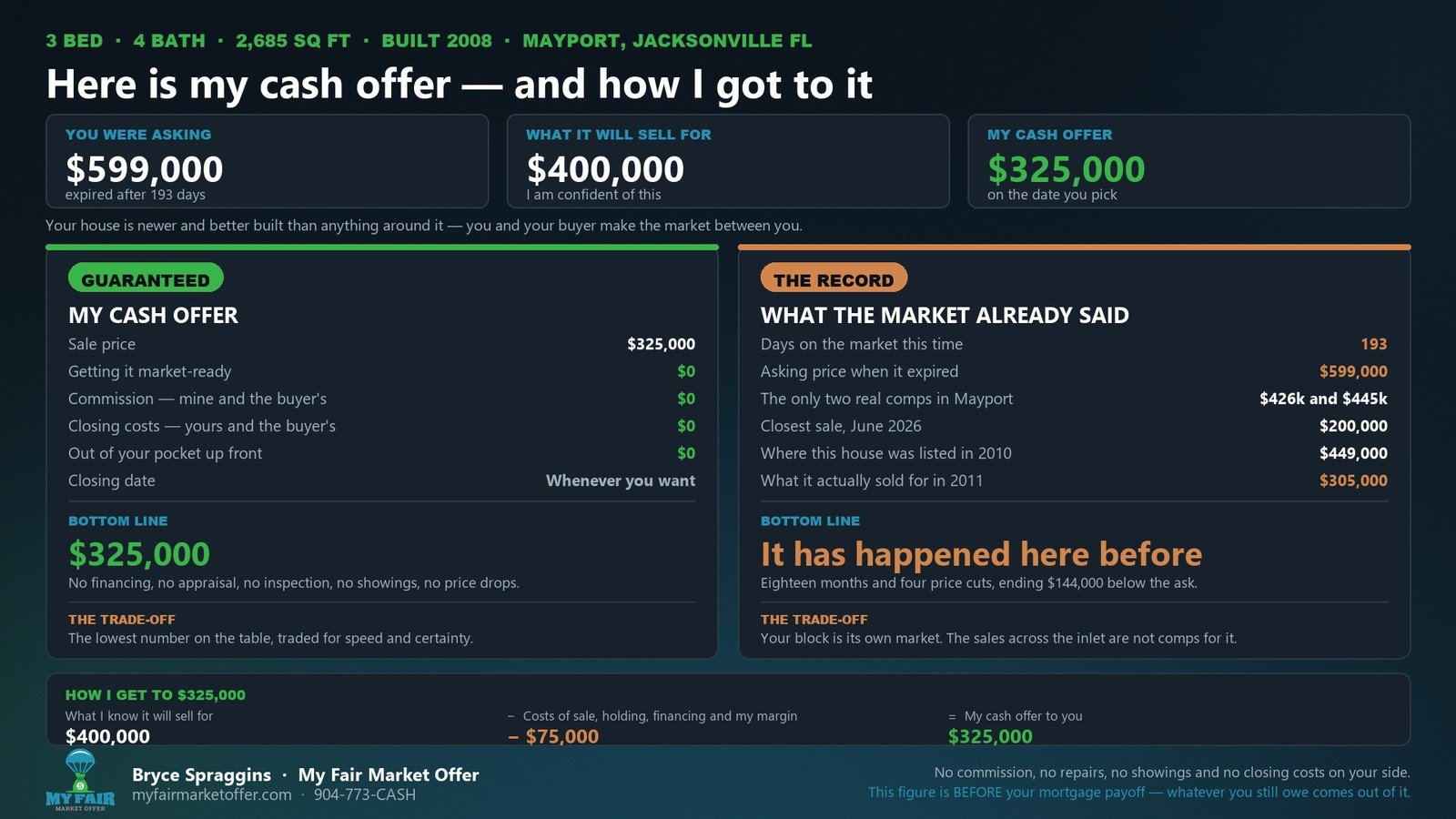
The property is a 2,685 sq ft home built in 2008 — 3 bedrooms, 4 baths — in Mayport. It was listed at $599,000, sat on the market for 193 days, and came off unsold. The owners had already stepped the price back more than once on the way.
The first problem was that the comparable sales barely exist. Pulling the immediate area out of the MLS returned two listings. Total. A second product, the kind that blends county records with MLS data to catch sales that never hit the market, returned a set that did not even contain those two — and the sales it did return were across the inlet. Geographically close, economically unrelated. That is not a comparable sale, it is a different market with water in between.
So the read was built by hand: the property appraiser roll, every sale in 2025 and 2026, narrowed to the specific pocket the house actually sits in. Most of what came back was well below the subject. Two sales were genuinely useful, at $426,000 and $445,000 — and both are older and less impressive than this house.
The second problem is that the house is overbuilt for its block. The homes around it run from about 961 to 1,759 sq ft. This one is 2,685. Being the nicest house on the street is a pleasant thing to own and a difficult thing to price, because there is no record of anyone in that neighborhood paying what this house is worth — nobody has had the chance. The seller and whoever finally buys it will set that number between them.
That is the part that changes a cash offer. When a house sits in the middle of a deep pile of recent sales, a cash home buyer can be confident about the resale and price accordingly. When the resale number has to be invented rather than observed, the margin has to widen to cover being wrong. It is not a comment on the house. It is a comment on how much the data can prove.
The history says the same thing. These owners bought it in 2011. That sale started at $449,000 in April 2010, stepped down to $448,000, then $445,000, then $390,000, and finally closed at $305,000 in October 2011 — eighteen months and four price cuts below where it began. The same house, the same block, the same problem.
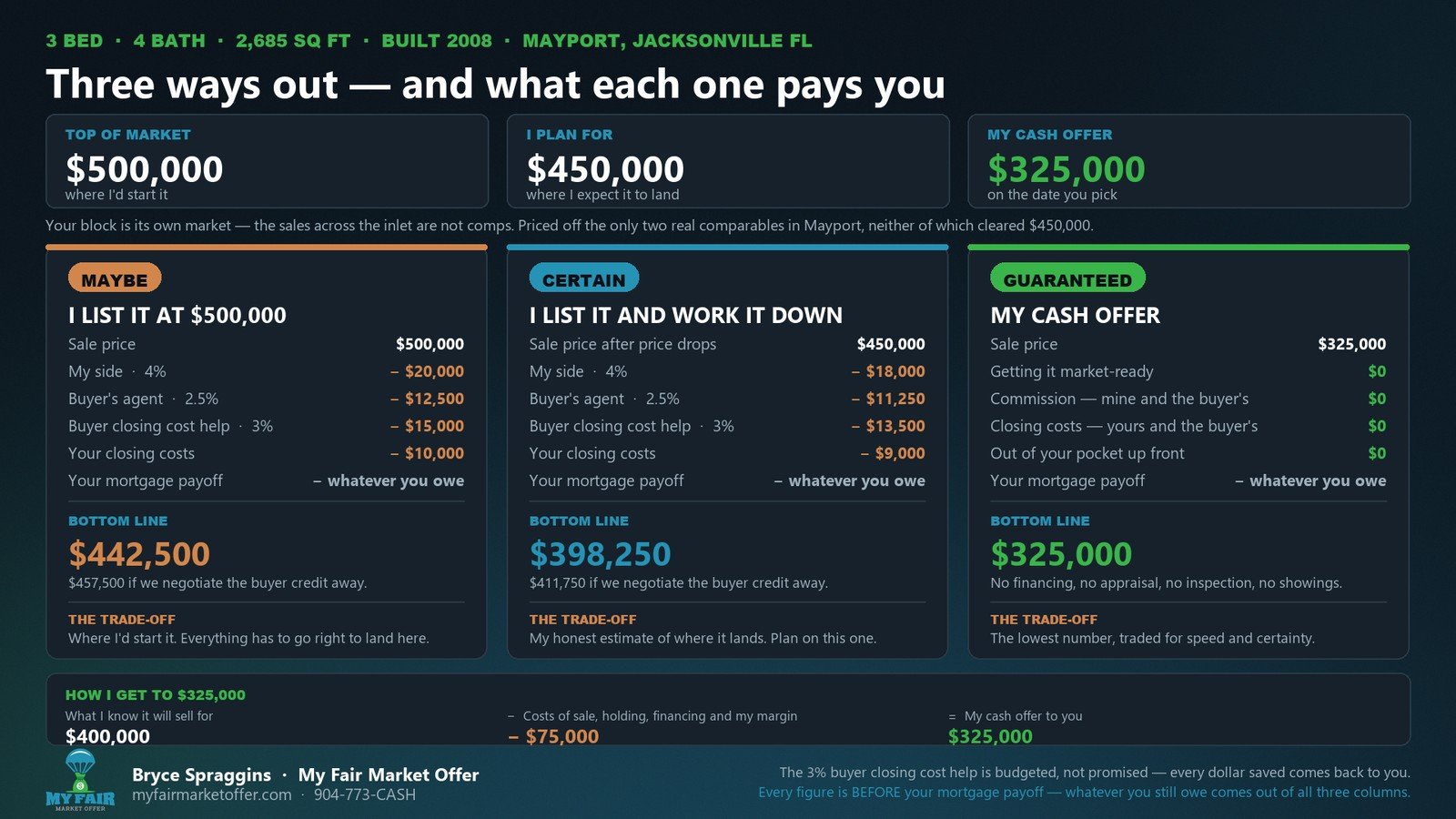
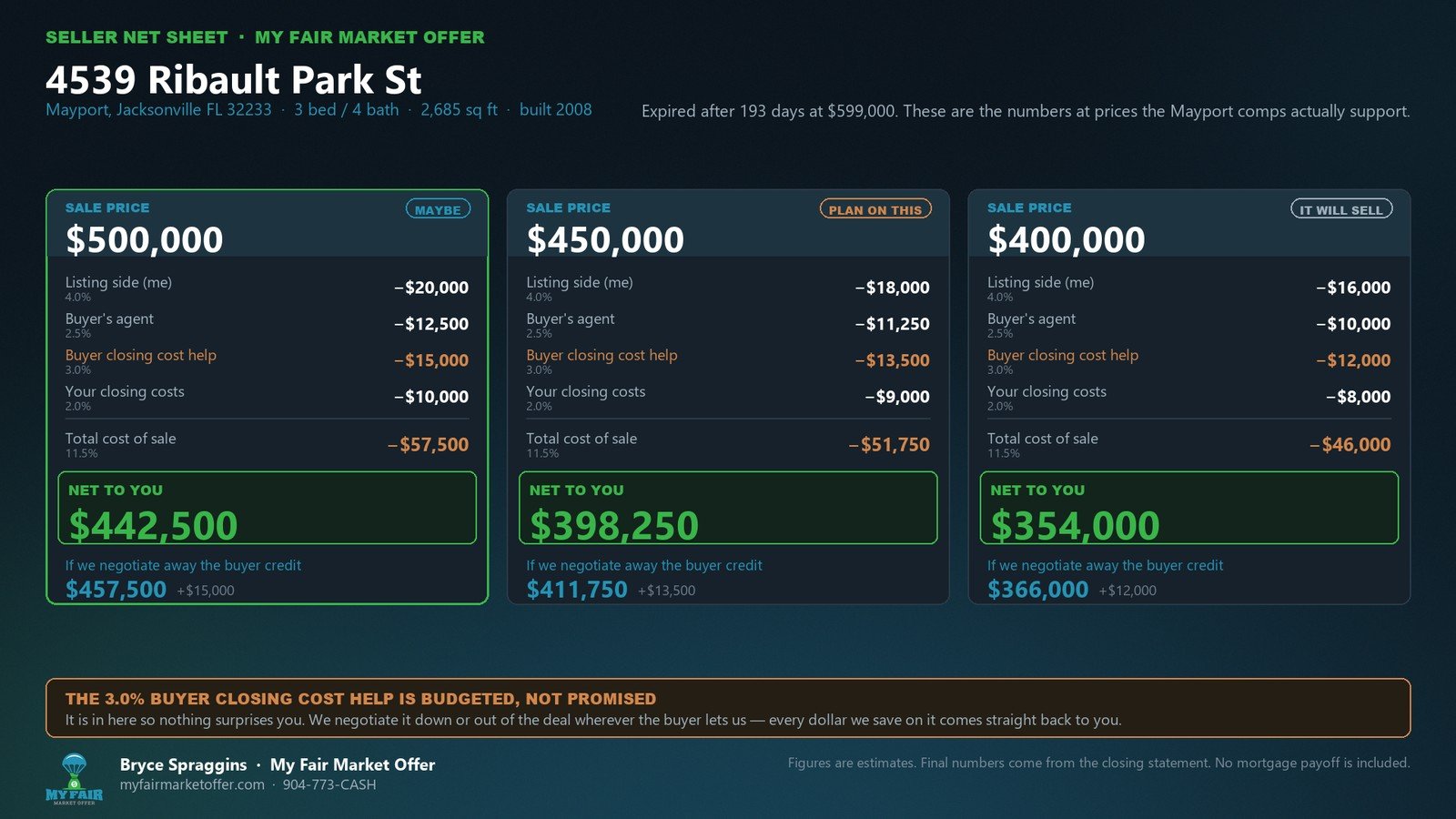
The retail plan. Priced today, it should start at $500,000 and work down. A sale between $450,000 and $500,000 is the realistic expectation, with $450,000 the honest middle. At $400,000 it sells — that is the number there is no doubt about.
The cash offer was $325,000, built off the $400,000 certainty rather than the $500,000 hope, with costs of sale, holding, financing and margin coming out of the difference. It closes on whatever date the sellers choose, with no commission, no repairs, no showings and no closing costs on their side.
And the recommendation was to turn it down — relist it, get it properly photographed, start at $500,000 and let it walk down to $400,000, because the spread between that and the cash number is worth the wait for a seller who can wait. The cash offer stands either way.
These are the real charts this offer was priced from — not a re-creation.
An appraiser or agent normally prices a home by finding recent sales of similar properties nearby and adjusting for the differences. When those sales do not exist — because the home is much larger, much newer, or otherwise unlike everything around it — there is nothing to adjust from. The practical result is that the price gets discovered rather than calculated: the seller picks a number, the market responds or does not, and the eventual sale becomes the comparable sale that did not previously exist. It also makes financing harder, because a lender’s appraiser faces the same empty cupboard the agent did.
It is excellent to live in and difficult to sell. The surrounding homes act as a ceiling on what buyers believe the location is worth, so an overbuilt home rarely captures the full value of what was spent on it. That is not a reason to avoid improving a property you intend to keep. It is a reason to expect a longer marketing time and a wider range of offers when you sell, and to be careful about renovating well past what the neighborhood supports if a sale is on the horizon.
Because most of them measure distance rather than comparability. A tool drawing a radius around a property treats everything inside that circle as a candidate, which works in a uniform subdivision and fails wherever the map has a boundary the algorithm cannot see — a river, an inlet, a highway, a rail line, a base perimeter. On this property the automated set returned homes across an inlet from the subject and omitted two sales on the correct side that the MLS already held. The reliable check is simple: if an automated comp set is missing a sale you already know about, throw the whole set out. It is not a gap in the data, it is evidence the geography is wrong.
Because the cash offer is built backwards from the resale price, and the resale price is the part that is uncertain. A cash home buyer takes the number the property will sell for with confidence, then subtracts costs of sale, holding and financing costs and a margin. Where recent sales are plentiful, the resale figure is well supported and the margin can be thin. Where the resale figure has to be estimated rather than observed, that margin has to absorb the risk of being wrong about it. On this property the offer was based on $400,000 — the price there was no doubt about — rather than the $500,000 the listing might reach.
It comes down to what the gap is worth against how long you can wait. On this property the cash offer was $325,000 with no commission, no repairs, no showings and a closing date of the seller’s choosing, against a realistic retail expectation of $450,000 to $500,000 that takes months and carries no guarantee. A seller who can wait, tolerate showings and absorb the carrying costs is usually better off relisting — properly re-photographed and priced to move rather than repeating the price that already failed. A seller who needs a date is buying certainty, and that is what the difference pays for.
Tell us about the house and you'll get a real as-is cash offer to purchase your home — no repairs, no showings, no commissions. Same process, same honesty, and you'll hear the number out loud.
Bryce will be there. You'll receive a calendar invite shortly.