A county assessed value is not market value. An assessment is a figure the property appraiser sets for tax purposes; market value is what a buyer will actually pay. They are usually close, and the assessment is usually the lower of the two — but not always. On this Clay County parcel the county assessment was $50,000 while comparable lots in the same subdivision were closing at $20,000, because roughly a dozen similar parcels were sitting unsold at around $40,000. When supply is that deep, the assessment can sit well above what the land will actually sell for.

Real Offers · Big Tree Lakes, Clay County

The County Says This Land Is Worth $50,000. It Sells for $20,000.

By Bryce Spraggins · September 5, 2026 · Seller chose another route

0.675 acres · raw land · priced off six months of sales inside the community

A landowner with a county assessment of $50,000 asked for a cash offer. The closed sales in his own subdivision said $20,000. Bryce showed the comps, made a $15,000 offer, and told him to go take the $35,000 offer he already had instead.

The address and the homeowner's name are never shown. Everything else — the condition, the comps, and the number — is exactly what happened.

The Offer

September 5, 2026

The comps, the county assessment, and why the answer was to take the other offer.

How This Number Was Built

This one ends with the seller being told not to sell to me. He mentioned he already had a $35,000 offer in hand. My honest advice was to go back to that buyer and take it, because I would not be anywhere close — and here is the arithmetic behind why.

The assessment is not the market. Clay County has the parcel assessed at $50,000, and the seller was right about the general rule: nine times out of ten a county assessment comes in below what a property will actually fetch. This is the tenth time. In a market with this much standing inventory, the assessment was well above what the land will move for.

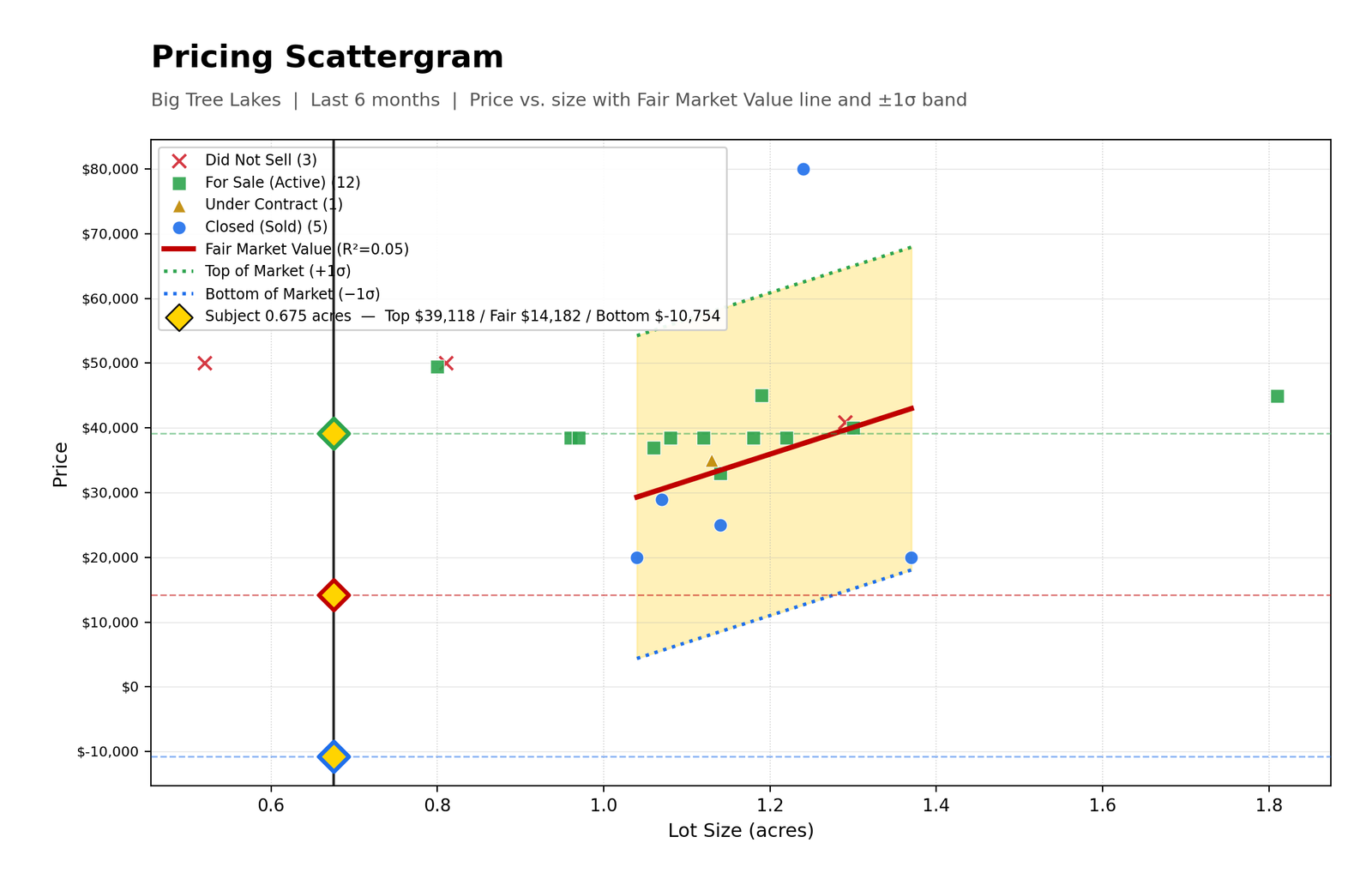
What the comps actually show. Every land sale and every attempt to sell inside the community, plotted against lot size. The wall of green squares is the story: roughly a dozen parcels sitting on the market around the $40,000 mark, several of them within a half-mile radius, and they are not moving. The blue dots are the ones that actually closed, and they sit at $20,000 to $29,000.

The supply problem underneath it. Twelve parcels listed, three more that already failed to sell, against five closings in six months. That is a sale every five weeks against a dozen competitors — call it fourteen months of inventory. Anything past six months is a buyer's market. Nobody has to buy this lot, which is exactly why the $40,000 asking prices keep sitting there.

The offer. If retail is $20,000 for a seller who genuinely needs it gone, a cash number lands at $15,000 — which happens to be what the seller originally paid. That is a real offer and it was made in writing. It is also plainly worse than the $35,000 already on his table, so the advice was to take that one. A cash offer is for speed and certainty. When somebody is already holding a better number, there is nothing to sell them.

The Actual Comps

These are the real charts this offer was priced from — not a re-creation.

Pricing scattergram for raw land in a Clay County subdivision showing twelve active listings around $40,000, five closed sales between $20,000 and $29,000, three unsold listings, and a fair market value regression line with an R-squared of 0.05
The actual scattergram this offer was read from. The green squares are parcels currently asking around $40,000; the blue dots are what actually closed, at $20,000 to $29,000. Read it across, not down the line: the trend line has an R&sup2; of <strong>0.05</strong>, meaning lot size explains about five percent of the price difference, and it prints a bottom of market of <strong>negative $10,754</strong> &mdash; a number that cannot exist, and the clearest possible sign the model is being pushed outside its data. The subject is 0.675 acres while every closed comp runs 1.04 acres or larger, so the line is extrapolating below everything it was built from. The closed sales are the number. (Click to enlarge.)

Common Questions

Is assessed value the same as market value?

No. Assessed value is set by the county property appraiser for tax purposes, while market value is what a buyer will actually pay on the open market. They are usually in the same range, and the assessment is more often the lower figure, but in an oversupplied market the assessment can sit well above what a property will sell for.

Why is my land assessed higher than what it will sell for?

Assessments are set on a schedule and lag the market, and they do not account for how many competing properties are for sale right now. If a dozen similar lots are listed and only a handful sell each year, buyers have no reason to pay the assessed figure, so actual sale prices fall below it.

How do you determine what raw land is worth?

By looking at what comparable parcels in the same area have actually closed at, not what they are listed at. Asking prices show what sellers want; closed sales show what buyers paid. On thin land markets the gap between the two is often large, and only the closed sales are reliable.

How much do land buyers pay compared to market value?

A cash purchase of raw land is generally priced below the retail figure, because the buyer is taking on the carrying cost and the risk of a slow resale. On this parcel the retail figure supported by closed sales was about $20,000 and the cash offer was $15,000, or roughly 75 percent.

What does it mean when land is listed but not selling?

It usually means the asking prices are above what buyers will pay. Standing inventory measured against the rate of closings gives the months of supply. Twelve parcels listed against five sales in six months is roughly fourteen months of supply, which is a deep buyer's market and puts downward pressure on price.

Related Resources

Want Your Own As-Is Cash Offer?

Tell us about the house and you'll get a real as-is cash offer to purchase your home — no repairs, no showings, no commissions. Same process, same honesty, and you'll hear the number out loud.