What This Video Covers
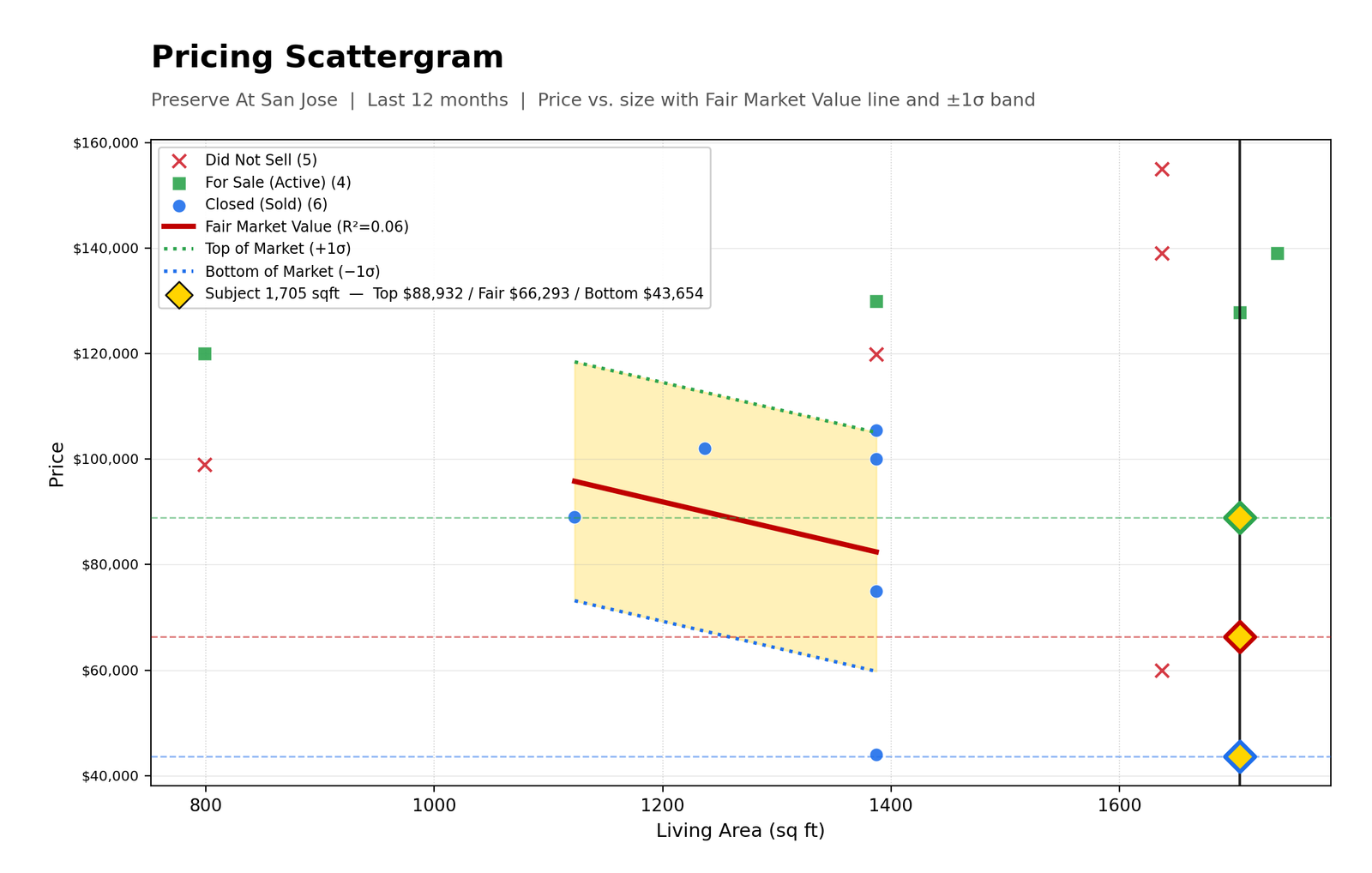
Owner financing is a good tool right up until the payments stop. This video is a real conversation with a seller who financed a condo, was not paid, and wanted to know what his actual options were. The valuation is done on camera first — comps pulled from inside that one condo community only, plotted on a scattergram covering every sale and every attempt to sell over two years.
What the comps said. The plot came back messy — the slope ran the wrong way, right to left instead of upward left to right, which is a sign of a thin, inconsistent market rather than a clean trend. Read conservatively, the ceiling for that building was about $125,000 retail on a good day, with $100,000 the number to plan around on a bad one. On a deal that size the margin needed is the greater of 20% or $40,000, which put the cash offer at $50,000.
Option 1 — Deed in lieu of foreclosure
Contact the buyer and ask him to sign a deed in lieu. It is a one-page form, and it hands the property back to the note holder without a foreclosure suit. Once it is signed, the property can be listed and sold on the open market. Retail is $125,000 on a good day, $100,000 on a bad one — and if the seller is willing to hold the mortgage a second time, $125,000 to $150,000 becomes reachable, because carrying the financing is what buys the higher price. The catch is obvious: holding the note again means carrying the same risk that produced this situation.
Option 2 — Sell the note
The note holder can sell the paper itself and never speak to the borrower again. The problem is what the paper is now worth. Non-performing notes trade at roughly 30% of face value. On a note written at $150,000 that is about $45,000 — landing in the same place as the cash offer on the property. Clean and immediate, but it is a real loss.
Option 3 — Sell the property to a cash home buyer
The occupant sells the condo directly, the note holder forgives the balance above what the sale brings, and everyone walks. Worth knowing what rides along with it: unpaid association dues have already gone to a third-party collector, and an association lien foreclosure may be filed without being recorded yet. Those arrears get paid at closing and come out of the number.
All three land close to the same figure, which is the honest lesson. Once a seller-financed loan goes bad, the recovery is set by what the property is actually worth — not by what the note says. The choice is really about speed, certainty, and how much further involvement anyone wants.
- What a deed in lieu of foreclosure is: one page, signed voluntarily, no foreclosure suit
- Why non-performing notes trade around 30% of face value
- How comps get pulled from inside a single condo community — and what a wrong-way scattergram slope tells you
- Why holding the mortgage buys a higher sale price, and what risk comes with it
- How unpaid association dues and a possible lien foreclosure come out of the closing number
- Why all three exits land at roughly the same number once a loan goes bad